
Change the state. Keep the company.
Move your corporation out of District of Columbia via redomestication.
Start the process of transferring your corporation out of District of Columbia in under five minutes.
Keep your existing contracts, credit history, and EIN.
Handled by a dually licensed attorney and CPA.
100% online. Flat-fee. No sales call required.








Executive Summary
Redomestication is the legal process of transferring a company out of District of Columbia to Florida, maintaining the existing federal employer identification number (FEIN), contracts, bank accounts, and in most cases, corporation name.
- No Downtime: When executed by a professional, there is no operational or financial disruption.
- Complexity: This process exists at the intersection of federal tax law and the laws of Florida and District of Columbia. It is not a "DIY" weekend project.
- Timeline: Redomestication takes about three months from start to finish, and expedite options are available. The intake process is entirely electronic, takes less than five minutes to get started, and can be completed on our redomestication platform here.
- Credentials: All work is handled by a dually-licensed attorney and CPA.
- Pricing: Pricing varies depending on the size of the company and is flat-fee.
- Get Started: No need to "request a quote." The exact price can be seen in under 30 seconds at the above link.
Move your corporation from District of Columbia to Florida without turning it into a second job.
You can see the exact price in under 30 seconds, complete the online intake in less than five minutes, and receive the documents for e-signature within 48 hours.
Seven answers you should demand before hiring anyone to redomesticate your corporation.
A redomestication from District of Columbia to Florida should not begin with uncertainty about price, timing, responsibility, or what happens if the filing encounters a problem.
| Ask this before you hire anyone | Cummings & Cummings Law | Any other provider |
|---|---|---|
| Can I see my exact price before I engage you? |
Yes. See the exact price online in about 30 seconds.
|
Often requires a sales call. Ask for the complete price in writing before you provide payment information. |
| How much of my time will the intake require? |
Less than five minutes for the online intake in a typical matter.
|
Ask whether calls, meetings, questionnaires, or manual document exchanges are required. |
| When will my legal documents be prepared? |
Within 48 hours after engagement and receipt of the required information. Faster if you choose to expedite.
|
Sometimes weeks. Ask for a specific preparation deadline, not an open-ended estimate. |
| Who actually prepares the legal work? |
Prof. Chad D. Cummings, CPA, Esq., M.S.T., LL.M., CMA, CFE, CIA, CRMA, CISA, CITP, FCPA, PFS, CFP personally prepares every document.
|
Confirm the name and credentials of the professional. Will it be an attorney, CPA, intern, paralegal? Where are they based? |
| Who submits and manages the state filings? |
We submit the required filings in District of Columbia and Florida and address
filing-office inquiries during the process.
|
Confirm whether the provider files both sides of the transaction or leaves part of the process to you. |
| Will I receive status updates while the states review the filings? |
Yes. We provide weekly status updates via email every Friday at no additional charge.
|
Many firms only provide updates upon request. Ask how often you will receive an update and whether updates cost extra. |
| What happens if the redomestication cannot be completed? |
We will refund your filing costs and 120% of the legal fees you paid if we are unable to obtain the approval of the Department of State.
|
Ask for the provider's remedy in writing before you engage the provider. Check their credentials and track record with the state bar, BBB, and Google Reviews. |
Redomestication changes where your corporation is domiciled, not the identity of the business itself.
When handled by a professional, the same legal entity continues uninterrupted from District of Columbia to Florida with no operational or financial disruption.
- Existing legal entity
- Existing FEIN
- Existing contracts
- Existing bank accounts
- Existing credit history
- Existing business history
- Same legal entity
- Same FEIN
- Same contracts
- Same bank accounts
- Same credit history
- Same business history
You provide the information and signatures. We take it from there.
Our engagement is designed for one task: changing the domicile of your corporation from District of Columbia to Florida while preserving the company's continuity.
If our redomestication process does not fit your corporation, we will tell you.
If the information you provide shows that our redomestication service cannot be used to move your corporation from District of Columbia to Florida, we will refund all of your costs and fees and inform you promptly before any instruments are filed. We will not waste your time or money.
In this circumstance, we will also suggest alternatives to explore with your tax professional, including referrals, where appropriate.
Your Redomestication Closing and Tax Continuity Packet.
After the redomestication from District of Columbia to Florida is complete, we deliver the closing materials and practical next-step instructions for you and your tax professional.
![How to move a corporation from Illinois to Florida [step-by-step process]](/onboard/yt-thumbs/wHrWpDhyc0k.jpg)
How to move a corporation from Illinois to Florida [step-by-step process]
![How to transfer an Illinois LLC to Florida and keep the EIN [step-by-step]](/onboard/yt-thumbs/KgcqPdhB5dI.jpg)
How to transfer an Illinois LLC to Florida and keep the EIN [step-by-step]
![Attorney and CPA: How to transfer a corporation to Florida from Georgia [step-by-step]](/onboard/yt-thumbs/zRbC-J9U-50.jpg)
Attorney and CPA: How to transfer a corporation to Florida from Georgia [step-by-step]
![Attorney and CPA: How to move an LLC from Georgia to Florida [step-by-step]](/onboard/yt-thumbs/gxiHRO--IOU.jpg)
Attorney and CPA: How to move an LLC from Georgia to Florida [step-by-step]
![How to transfer a corporation out of New York to Florida [step-by-step]](/onboard/yt-thumbs/jl5bCTnaymg.jpg)
How to transfer a corporation out of New York to Florida [step-by-step]
![How to transfer an LLC out of New York to Florida [step-by-step]](/onboard/yt-thumbs/MVGZINVvd14.jpg)
How to transfer an LLC out of New York to Florida [step-by-step]

Steps to transfer a company (LLC or corporation) to Florida
Report: Billionaire Stephen Ross says South Florida’s business relocation push in the '1st inning'

Report: How Much Americans Save on Taxes by Moving to Florida

Report: Years to Save for a Home by State and Why Business Owners Are Moving to Texas and Florida
Report: Why Are So Many Companies Moving to Florida?

Report: Here’s How Much L.A. and Silicon Valley High-Earners Could Save by Moving to Florida
How to move a corporation from Illinois to Florida [step-by-step process]
How to transfer an Illinois LLC to Florida and keep the EIN [step-by-step]
Attorney and CPA: How to transfer a corporation to Florida from Georgia [step-by-step]
Attorney and CPA: How to move an LLC from Georgia to Florida [step-by-step]
How to transfer a corporation out of New York to Florida [step-by-step]
How to transfer an LLC out of New York to Florida [step-by-step]
Steps to transfer a company (LLC or corporation) to Florida
Report: Billionaire Stephen Ross says South Florida’s business relocation push in the '1st inning'
Report: How Much Americans Save on Taxes by Moving to Florida
Report: Years to Save for a Home by State and Why Business Owners Are Moving to Texas and Florida
Report: Why Are So Many Companies Moving to Florida?
Report: Here’s How Much L.A. and Silicon Valley High-Earners Could Save by Moving to Florida
Update October 2026: State legislatures are considering various legislative proposals that could change how a corporation is taxed in District of Columbia, including the possibility of new wealth, income, and capital gains taxes for the corporation and its owners. If you are considering relocating your corporation to Florida, time is of the essence.
Several jurisdictions outside of Florida are considering sweeping changes to state tax law which could result in a corporation and its owners paying tens of thousands, or in some cases, hundreds of thousands of dollars in new taxes. For a corporation considering redomesticating to Florida, this should be at the forefront of any tax planning discussion. Redomestication, when coupled with a change of residency to Florida and a reduction or cessation of business activity in District of Columbia, can be an effective way to reduce or eliminate tax nexus in District of Columbia, thereby yielding lower taxes for the corporation and its owners. Ask your CPA for more information.
Table of Contents
- The Redomestication Process in a Nutshell
- Requirements to Transfer a corporation from District of Columbia to Florida in 2026
- Why hire Cummings & Cummings Law to transfer your corporation from District of Columbia to Florida?
- Legal requirements for moving your corporation to Florida (updated October 2026)
- The sequence of moving a corporation to Florida from District of Columbia
- How long does it take to move a corporation from District of Columbia to Florida?
- How much does it cost to transfer a corporation from District of Columbia to Florida?
- Tax considerations when moving a corporation from District of Columbia to Florida (updated October 2026)
- Specific requirements to transfer a corporation to Florida from District of Columbia
- Redomestication vs. Foreign Registration vs. Merger vs. Dissolution: A Comparison
- Frequently asked questions: moving a corporation to Florida from District of Columbia
- Common misconceptions about redomestication
The Redomestication Process in a Nutshell
1. Enter your biz name on our portal here.
Then click "get exact price" and follow the steps.
Takes less than five minutes to start, and then our attorneys get to work.
Submit payment securely online then sit back and relax.
2. We prepare the legal docs.
Our dually-licensed attorney+CPA prepares the legal documents and sends them to you via DocuSign.
You sign. We take it from there.
3. We submit the legal filings to the states.
We monitor the status closely, respond to inquiries from their offices, and send you weekly updates.
No extra charge. 100% success rate.
4. Approved! ✅
We send you a checklist of go-forward obligations and simple steps for your tax pro to follow.
120% money-back guarantee if we do not succeed.
Still have questions? Schedule a meeting with our attorney and CPA.
Redomestication, also known as redomesticating, refers to the lesser-known legal process of transferring or moving the "home state" of an existing corporation, partnership, or LLC to a new state. It means keeping your existing company name, credit, and federal employer identification number (FEIN) without wasting time and money creating a new business entity, applying for foreign registration, or moving assets between companies.
— Prof. Chad D. Cummings, CPA, Esq., M.S.T., LL.M., CMA, CFE, CIA, CRMA, CISA, CITP, FCPA, PFS, CFP
Requirements to Transfer a corporation from District of Columbia to Florida in 2026
Overview: how redomestication works
Welcome to the complete guide for moving your corporation from District of Columbia to Florida presented by Cummings & Cummings Law, a Florida law firm focused on the legal process of redomestication.
Moving your corporation from District of Columbia to Florida can offer significant advantages, particularly if you're seeking a more favorable tax environment or streamlined business regulations. Florida is known for its business-friendly policies, including no state income tax, which can lead to substantial savings for your corporation. Before initiating the process, it's essential to evaluate your current setup in District of Columbia and ensure compliance with both states' requirements to avoid any legal pitfalls.
The redomestication process typically involves filing specific documents with the secretaries of state in both District of Columbia and Florida. This includes preparing a plan of redomestication, obtaining board and shareholder approvals if applicable, and submitting articles of redomestication in Florida. Unlike simply registering as a foreign entity, this method allows your corporation to fully transition its domicile, shedding ongoing obligations in District of Columbia while retaining your federal EIN and business continuity.
Once approved, your corporation will operate under Florida's laws, potentially benefiting from asset protection and operational flexibility unique to the state. However, consulting with legal and tax professionals familiar with both District of Columbia and Florida is crucial to navigate any nuances, such as franchise taxes or entity conversion rules. This strategic move can position your corporation for long-term growth in a more supportive jurisdiction.
Why hire Cummings & Cummings Law to transfer your corporation from District of Columbia to Florida?
Cummings & Cummings Law offers the combined technical and practical experience of a licensed Florida attorney and CPA, with fiduciary duties owed to every client under the law. Redomestication is not a form-filling exercise; it is a continuity project that must preserve the legal and tax identity, governing authority, and operational relationships of the corporation while shifting its state of domicile to Florida. A dually-licensed professional reduces coordination failure, reduces rework, and reduces the risk that a client receives inconsistent guidance from separate professionals who do not share the same case file.
The attorney relationship imposes fiduciary duties that services like LegalZoom® and RocketLawyer® do not owe. As Justice Benjamin Cardozo expounded in Wendt v. Fischer (1926): a fiduciary “is held to something stricter than the morals of the market place. Not honesty alone, but the punctilio of an honor the most sensitive, is then the standard of behavior.” If you hire a non-attorney to perform the work of an attorney, caveat emptor.
Our firm has completed 500+ redomestications with a 100% success rate and offers a 120% money-back guarantee. Our service model provides a flat-fee structure, a typical timeline of three months, available expedite options, and weekly status updates at no additional charge. All work is performed by the attorney and CPA who signs the filings. No work is delegated to apprentices, assistants, or third-party vendors.
Legal requirements for moving your corporation to Florida (updated October 2026)
Redomesticating your corporation from District of Columbia to Florida is governed by Chapters 605, 607, and 621 of the Florida Statutes and the law of District of Columbia.
It is also governed by Sections 351, 355, and/or 368(a) of the Internal Revenue Code and applicable Treasury Regulations.
Few legal transactions implicate such a broad cross-section of state and federal law with several intersecting points, and laws updated in 2026 present hidden landmines for inexperienced attorneys and do-it-yourself filers alike.
Florida law requires, among other things, the preparation and execution of:
- Articles of Incorporation: the legal document which establishes your corporation as a Florida organization, identifies who will control the corporation, the management structure, the name of the corporation, and the principal office in Florida;
- Articles of Conversion or Redomestication: the legal document tells the Florida Department of State that the corporation is redomesticating from District of Columbia, is continuing in existence under the same or a different name, and is not a new entity (this is very important, because even if the same name is used, without this and other documents, below, the corporation will be treated as a new, distinct company from that in District of Columbia with serious legal and tax consequences);
- a legal Plan of Conversion: the formal document which establishes, among other key points, how ownership of the corporation will be converted and apportioned, that the existing bank accounts, contracts, assets, liabilities, benefits, and obligations of the District of Columbia corporation will continue with full force and effect in Florida, and how the federal employer identification number (FEIN) and existing federal tax elections will remain unchanged by the redomestication;
- board meeting minutes and/or a unanimous written consent of the corporation authority adopting and approving the Plan of Conversion: this is the document which legally ratifies the Plan of Conversion and makes it legally binding upon the corporation and its owners, and
- a legal instrument filed with the appropriate authority of District of Columbia.
Of these documents, the most important is the legal Plan of Conversion. Without this instrument, documents filed with the Florida Department of State and with District of Columbia may have no legal effect, or worse, result in the inadvertent dissolution of your company. Only templates for the Articles of Incorporation, Conversion, and Redomestication are available on the Florida Department of State website, and these templates are insufficient for completing a redomestication. The Plan of Conversion, board meeting minutes, and the District of Columbia statement of conversion must be bespoke, custom legal documents that address the legal particulars of the redomestication. Templates found on other websites will be, at best, incomplete, and at worst, result in the termination of your company with unpredictable legal and tax consequences.
It is illegal to file Articles of Conversion or Redomestication unless a legal Plan of Conversion has first been adopted and approved with the requisite formalities. The Plan of Conversion and board meeting minutes must be kept on file indefinitely at the principal place of business, and copies must be furnished to all persons having information rights in the corporation under Florida law. Failure to do so is a violation of Florida law and can result in lawsuits and other sanctions.
The sequence of moving a corporation to Florida from District of Columbia
Timing is everything. There is a strict, mandatory sequence which must be assiduously observed when transferring a corporation from District of Columbia to Florida. Ignoring this sequence, or proceeding out of order, will result in the inadvertent termination of the corporation, which may be a taxable event, the formation of a duplicate corporation (which creates serious tax headaches), or the devolution of the liabilities of the corporation to its owners. This is lawyer-speak meaning that, if not performed correctly and sequentially, the liabilities (known, unknown, past, present, and future) of the corporation become the personal obligations of the owners, potentially resulting in bankruptcy and financial ruin.
The general sequence is as follows:
- First, a legal Plan of Conversion must be drafted and submitted to the owners of the corporation;
- Second, the owners of the corporation must discuss and vote upon the legal Plan of Conversion, either at a properly-called meeting or via a unanimous written consent;
- Third, the Articles of Incorporation and Conversion or Redomestication are filed with the Florida Department of State and subject to a review and approval period;
- Fourth, only after the Florida Department of State has approved the redomestication, the statement of conversion is filed with District of Columbia, which is subject to an additional review and approval period.
Tax returns must be filed in District of Columbia, and if necessary, tax accounts must be closed and returns marked as final; otherwise, the taxing authorities in District of Columbia may continue to assess penalties and interest for unfiled returns or unreported revenue.
How long does it take to move a corporation from District of Columbia to Florida?
An experienced attorney can prepare documents within 48 to 72 hours. Once the Articles of Incorporation and Redomestication or Conversion are filed with the Florida Department of State, the review period may range from two weeks or less when submitted by an attorney to over eight weeks when submitted by mail. Normal, non-expedited processing dates are viewable here: Florida Department of State, Division of Corporations Document Processing Dates. After approval, the statement of conversion must be submitted to District of Columbia, which triggers a subsequent review period of six to eight weeks depending on the processing backlog of District of Columbia.
The entire process can require as little as three weeks when expediting fees are paid through an attorney or as long as six months when handled by a novice. The average range is two to three months. In contrast, dissolution is a thirteen-step legal process that can take six to twelve months, and when our firm is retained to fix a failed redomestication, the average time to remedy the situation ranges from six to twelve months.
How much does it cost to transfer a corporation from District of Columbia to Florida?
Legal fees for redomesticating a single-owner company start just under $2,000, plus state-imposed filing costs that vary by jurisdiction. Our most updated pricing can be viewed here: costs to move a corporation from District of Columbia to Florida, where the intake process can be completed on our website in under five minutes, and then our attorneys get to work. Our firm charges a flat-fee for redomestications of any corporation with five owners or fewer. A single-owner corporation should expect to pay less than a multi-owner entity.
By comparison, a traditional merger may cost as much as $20,000 or more, dissolution can reach five or six figures, and fixing a failed or incomplete redomestication routinely exceeds $15,000 and in some cases cannot be fixed at all. Online filing services may charge less, but these services often prepare and file documents incorrectly and may be practicing law without a license, which is illegal in both Florida and District of Columbia.
If your corporation has complex structures or ongoing operations tied to District of Columbia, consider the timeline—approvals can take several weeks to months.
Ultimately, relocating to Florida via redomestication empowers business owners to optimize their setup without the hassle of dissolving and reforming the entity anew.
Tax considerations when moving a corporation from District of Columbia to Florida (updated October 2026)
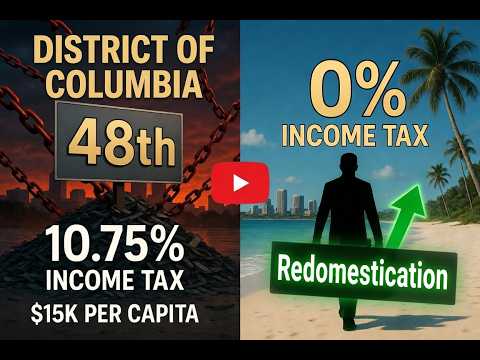
District of Columbia imposes a graduated individual income tax with seven brackets and rates ranging from 4.00 percent to 10.75 percent on taxable income exceeding $1 million. The District also imposes an 8.25 percent corporate franchise tax on C corporations with DC-source income. Unlike most jurisdictions, the District imposes a separate Unincorporated Business Franchise Tax (UBFT) of 8.25 percent on the net income of LLCs, partnerships, and certain sole proprietorships with DC gross receipts exceeding $12,000, with a minimum tax of $250 (or $1,000 if DC gross receipts exceed $1 million). This means that pass-through entities doing business in the District are taxed at the entity level, a material distinction from most states. A 30 percent salary allowance for owners and a $5,000 statutory exemption are deductible from net income before the UBFT is computed. Businesses where more than 80 percent of gross income is derived from personal services and capital is not a material income-producing factor are exempt from the UBFT. The District ranks 48th on the Tax Foundation's 2026 State Tax Competitiveness Index (phantom rank; does not affect the rankings of the 50 states). More information is available from the Tax Foundation and the DC Office of Tax and Revenue.
District of Columbia imposes a 6.00 percent sales tax with no local add-on, producing a uniform 6.00 percent rate throughout the District. The District imposes a state-level estate tax with an exemption significantly lower than the federal threshold, and estate tax rates range up to 16.00 percent. Property tax rates in the District are moderate relative to surrounding jurisdictions in Maryland and Virginia, but assessed values in DC tend to be high, producing significant annual property tax bills. For owners of a corporation redomesticating from District of Columbia to Florida, the District's entity-level Unincorporated Business Franchise Tax on pass-through entities is a distinctive and often overlooked cost that does not exist in most states. The combination of a 10.75 percent top individual income tax rate, an 8.25 percent entity-level tax on unincorporated businesses, an estate tax, and a phantom ranking of 48th on the Tax Foundation Index make the District one of the most expensive jurisdictions in the nation for business owners.
Florida is one of a handful of states with no state income tax at the personal level. This means individuals are not taxed on their income by the State of Florida. Most businesses pay no income tax at the corporation level, because Florida does not impose an income tax on pass-through entities, and subchapter C corporate income is taxed at 5.5% above $50,000. This makes Florida one of the most tax-advantaged jurisdictions in the United States and globally.
Redomestication, when coupled with a reduction or cessation of business activity in District of Columbia, can be an extremely effective way to reduce or even eliminate District of Columbia taxes.
Businesses in Florida still may be liable for other forms of tax, such as payroll and sales and use taxes as in other states. More information on this is available from the Florida Department of Revenue.
Also, because of the legal doctrine of tax nexus, businesses with income sourced from states outside of Florida may still be taxed on that income by those other jurisdictions. This means that businesses continuing their operations in other states, which may include, for example, selling goods, retaining or hiring employees, maintaining a physical presence such as an office or a warehouse, or otherwise deriving revenue from outside of Florida may still be required to file and pay tax returns in those states. See South Dakota v. Wayfair, 585 U.S. ____ (2018), but see Wisconsin Dept. of Revenue v. William Wrigley, Jr. Co., 505 U.S. 214 (1992). Ask your CPA for more information and to perform a state-by-state nexus analysis if they have not already done so, as thresholds and requirements vary expansively by state.
Specific requirements to transfer a corporation to Florida from District of Columbia
Moving a corporation from District of Columbia to Florida is entirely possible, but District of Columbia has specific laws that must be strictly followed, and the process varies from other jurisdictions.
Many business owners are wrongly told that it is impossible or impractical to transfer a corporation out of District of Columbia, but that is simply false. There are three primary reasons for this misinformation:
- first, many attorneys are unaware of the statutory authority for District of Columbia redomestications;
- second, District of Columbia uses different terminology which hinders understanding; and
- third, District of Columbia law requires the preparation of a legal Plan of Conversion, which online filing services cannot prepare (and as a result, these services will instead tell their customers that it is impossible to transfer a corporation out of District of Columbia, which is patently false).
Legal requirements to move a corporation to Florida from District of Columbia
Moving a corporation from District of Columbia to Florida is much more than filling out a couple of templates and mailing a check to the Florida authority. Here are some of the District of Columbia-specific legal requirements to consider when redomesticating a corporation to Florida:
- District of Columbia uses the term domestication to refer to redomestications and requires the filing of a Statement of Domestication (or equivalent instrument) with the District of Columbia Department of Licensing and Consumer Protection (DLCP), Corporations Division, governed by D.C. Code § 29-809.06 et seq. for LLCs and D.C. Code § 29-307.01 et seq. for corporations.
- Before filing, the entity must adopt a Plan of Domestication approved by the requisite vote of the owners under DC law; the plan must set forth the terms and conditions of the domestication, including the manner and basis for converting ownership interests in the domesticating entity.
- The DLCP does not publish a standard form for outbound domestications on its website; the entity must prepare a custom legal instrument in compliance with D.C. Code Title 29.
- The District requires the entity to be in good standing and current on all biennial report filings with the DLCP before the redomestication filing will be accepted.
- The District of Columbia filing costs to redomesticate out of the District of Columbia should be confirmed with the DLCP Corporations Division, as the fee schedule does not enumerate a separate outbound domestication line item; the fee is generally equivalent to the registration fee for the same entity type (approximately $389), plus any applicable certified copy and expedited processing fees, in addition to the Florida state filing costs. These costs are exclusive of legal fees.
- Contrary to popular belief, a certificate of good standing from District of Columbia is not required to complete the redomestication, though the entity must be in good standing with the DLCP at the time of filing.
- Because the DLCP does not publish a standard form, the custom filing instrument must be drafted from scratch to satisfy D.C. Code Title 29. This makes the District one of the more challenging jurisdictions for do-it-yourself redomestications, as the DLCP will reject instruments that do not comply with the statutory requirements in both form and substance.
- The District operates on a biennial report cycle. The entity should confirm that no report is due during the period between adoption of the plan and the expected filing date to avoid a lapse in good standing.
- Unlike most states, the District imposes an entity-level tax on pass-through entities through the Unincorporated Business Franchise Tax (UBFT). The entity should coordinate with its tax professional to file final DC franchise tax returns (Form D-20 for corporations or Form D-30 for unincorporated businesses) and close any open accounts with the DC Office of Tax and Revenue. Failure to close franchise tax accounts with OTR can result in continued minimum tax assessments and penalties even after the entity has departed the District.
- The internal Plan of Domestication should function as the transaction record, not as a one-sentence authorization. The statutory framework in D.C. Code §§ 29-809.06-.07 should be checked against the governing documents before approval. As a matter of transaction drafting, the record should identify the entity before the domestication, the entity that will exist under the law of Florida, the transaction terms, and the treatment of each ownership interest. For an outbound District LLC domestication, the statutory default requires consent of all members, subject to the personal-liability protections in the statute. The consent should address each member's post-transaction interest and should not rely on a general amendment clause as a substitute for transaction approval. The signed approval should cite the operating agreement, bylaws, articles, shareholder agreement, or statutory default that supplies the voting rule. Where the cited provisions apply to one entity type, the corresponding corporation, partnership, professional-entity, or nonprofit statute must be reviewed before the same procedure is used for another entity type.
- The Statement of Domestication and the proposed Florida filing should be reconciled line by line before either document is released for filing. For an entity type covered by the cited provisions, the filing requirements in D.C. Code § 29-809.08 and the current instructions published by the District of Columbia Department of Licensing and Consumer Protection, Corporations Division should be used to determine the required legal names, entity types, jurisdictions, state identification numbers, approval recitals, service information, signature authority, attachments, and effective-date language. If either jurisdiction requires evidence that the other filing has been accepted, the closing instructions should specify the filing sequence, the person responsible for obtaining the file-stamped or certified evidence, and the deadline for supplying it. Where delayed effectiveness is available, both records should use a coordinated date and time; where it is not, the filing sequence should minimize any inconsistent public-record status.
- For an entity type covered by the cited provisions, the effect provisions in D.C. Code § 29-809.09 should be read together with the law of Florida to determine the transaction's effect on entity identity, property, rights, debts, obligations, and liabilities. The closing memorandum should identify which jurisdiction's law supplies each part of the continuity analysis. That statutory continuity does not amend a private contract, government license, permit, insurance policy, bank mandate, lease, financing document, UCC record, professional registration, or benefit plan. Before effectiveness, the entity should review provisions addressing conversion, domestication, merger, transfer, assignment, change of domicile, notice, and consent. Any required consent should be obtained in writing, and any required notice should identify the same effective date used in the state filings.
- After the transaction becomes effective, the entity should decide whether the Florida entity will continue to transact business in District of Columbia. If it will, foreign qualification, a District of Columbia registered agent or statutory agent, and continuing tax or licensing accounts may remain necessary. If it will not, state tax, payroll, unemployment, sales-and-use, local-license, and regulated-industry accounts should be closed only after file-stamped evidence is available. The permanent closing file should contain the signed plan, owner and manager or board approvals, the accepted District of Columbia and Florida filings, status evidence, tax correspondence, third-party consents, notices, and a post-closing responsibility schedule.
Click Here to Start Your Redomestication Now
Redomestication vs. Foreign Registration vs. Merger vs. Dissolution: A Comparison
Redomestication is a distinct legal process from foreign entity registration, merger, or dissolution.
Redomestication is generally the most efficient and cost-effective method for relocating a business to a new state, particularly when the company has permanently ceased operations in its original state. It does not involve dissolution. Many people make the mistake of dissolving their company when relying on incomplete or misleading advice.
Unlike foreign entity registration or merger, redomestication allows a business to retain its EIN, contracts, credit history, and brand identity—preserving continuity while minimizing tax risks and administrative burdens. It also eliminates the need to maintain dual registrations and tax obligations, potentially saving substantial time and money. By contrast, foreign registration can create ongoing compliance costs in the former state, and mergers often involve unnecessary legal complexity and higher fees.
Redomestication is, in many circumstances, far preferable to registering an LLC or corporation as a foreign entity, especially where the LLC or corporation has permanently moved its operations and will not be returning to the prior state in the near future.
Some attorneys, unfortunately, confuse their clients by recommending a foreign entity registration in the new state, or worse, a merger, where a redomestication would have accomplished the goals of moving their business to a new state efficiently and effectively.
The top seven benefits of moving your company (LLC, corporation, or partnership) to a new state via redomestication to transfer your business include:
- Maintaining your existing federal employer identification number, eliminating the tax headaches of forming a new company or transferring assets between companies (and inadvertently triggering a hefty tax bill from the IRS) when you move your business to a new state;
- Keeping your existing business credit history and track record, safeguarding your reputation with clients, vendors, and creditors when moving your LLC or corporation to a new state;
- Continuing your existing business name (in almost every case), protecting your most important assets when moving your company to a new state: your brand, reputation, and time you have already invested in search engine optimization;
- Maintaining your existing contracts with customers and vendors because moving your business to a new state via redomestication does not create a new company: it maintains your existing company, saving you dozens (or even hundreds) of hours re-writing (and re-negotiating) contracts and changing banks;
- Eliminating the need to continue paying registration fees and taxes in your prior state (assuming you have discontinued your operations there and have permanently relocated to a new state), potentially saving you tens of thousands of dollars (or more) in state taxes every quarter when you move your business to a new state;
- Avoiding unnecessary IRS scrutiny because moving your LLC or corporation to a new state via redomestication is a tax-free transaction under the Internal Revenue Code; and
- Reducing the amount of time you spend on administrative filings, saving you untold hours annually, by moving your company to a new state.
Before taking the "penny wise and pound foolish" approach of foreign entity registration or spending countless hours and exorbitant legal fees (and possibly taxes) on a merger or merger-gone-wrong to move your company to a new state, ensure you understand your options.
| Redomesticate | Foreign Entity | Merge | Dissolve | |
|---|---|---|---|---|
| Need to Continue Paying & Filing Registration Renewals in Former State | ✅ No | ❌ Yes | ⚠️ Varies | ☠️ No, she's dead, Jim. |
| Stop Paying Taxes in the Former State* | ✅ Yes | ❌ No | ⚠️ Varies | ☠️ Tax event.* |
| Initial Complexity | ✅ Low | ⚠️ Varies | ❌ High | ❌ High, when done right. |
| Ongoing Complexity | ✅ Very Low | ❌ High | ❌ High | ☠️ None. All gone. |
| Initial State Filing Costs | ✅ Low | ⚠️ Varies | ❌ High | ⚠️ Varies |
| Timing | ✅ Fast | ⚠️ Varies | ❌ Slow | ⚠️ Varies |
| Legal Fees | ✅ Low | ⚠️ Varies | ❌ $10,000 or more | 🔥 Very high to fix. |
| *While every situation is different and dependent upon tax nexus, redomesticating can be an effective way to reduce or eliminate taxes in a former state in certain circumstances. Ask your CPA for more information. Our firm does not provide tax advice or perform tax work except by separate engagement at an additional charge. | ||||
In most circumstances, redomestication (and not a foreign entity registration or costly and complicated merger) is the best route to achieve a change in company domicile to a new state.
Why is redomestication the superior option to move a corporation from District of Columbia to Florida?
Redomestication keeps the business alive while moving its legal home to Florida, which can allow the business to stop paying and filing annual registration renewals in District of Columbia if it has ceased operations there. The tax outcome depends on the facts and tax nexus, but the result is often that the redomesticated corporation has no remaining connection to District of Columbia, which can reduce or eliminate District of Columbia tax exposure.
Why is foreign entity registration inferior to redomestication when moving a corporation from District of Columbia to Florida?
Foreign entity registration keeps the corporation domiciled in District of Columbia and registers it to do business in Florida, which means continuing to pay and file renewals and taxes in District of Columbia. The business now manages two or more state compliance tracks, increasing the chance that a missed renewal, registered agent change, or notice triggers penalties, loss of good standing, or disputes with banks and regulators.
Why is a traditional merger usually the wrong way to move a corporation from District of Columbia to Florida?
A traditional merger is a slower, higher-complexity path with legal fees that can reach $10,000 or more, and six or seven figures for complex transactions. When performed incorrectly, a merger may be a taxable event. The merger process also creates follow-on work: re-titling assets, harmonizing governing documents, novating and re-negotiating existing contracts, establishing new bank accounts, and repairing overlooked items that can surface years later. A single missed consent or broken assignment clause can convert a planned administrative exercise into a dispute or business interruption.
Why is dissolution the wrong way to move a corporation to Florida from District of Columbia?
Dissolution kills the corporation. There is nothing left to move. Even if you think your corporation is dormant, breaches of contract, tax liabilities, and other claims may not surface until years down the road. If the corporation is dissolved, those claims may subject your personal assets to unlimited personal liability because the veil of protection for your corporation no longer exists. Dissolution can also trigger a taxable event under the Internal Revenue Code and the laws of District of Columbia. Redomestication, when performed by a competent attorney, is a non-taxable event.
Unless you are closing your doors and going out of business, dissolution should not enter the equation. If other professionals are suggesting dissolution, seek a second opinion. If you dissolve your corporation, you are not moving it; you are pulling the plug.
Frequently asked questions: moving a corporation to Florida from District of Columbia
Below are some of the most commonly asked questions our firm receives from business owners interested in transferring their corporation to Florida from District of Columbia, prepared by a dually-licensed Florida attorney and Certified Public Accountant.
-
1. What is redomestication?
Redomestication is the statutory conversion of a corporation from District of Columbia to Florida under the Florida conversion statute (Fla. Stat. § 605.1041 et seq.). The corporation retains its Federal Employer Identification Number, contracts, bank accounts, credit history, and legal continuity. No new entity is formed and no assets transfer.
Redomestication is the process of legally transferring a corporation's home state from District of Columbia to Florida. The corporation retains its existing name, credit history, contracts, bank accounts, and federal employer identification number (FEIN) without creating a new entity, transferring assets, triggering federal income tax, applying for foreign registration, or dissolving the original corporation.
The corporation that exists after the redomestication is the same legal entity that existed before. It carries forward all prior history, rights, obligations, and liabilities as a matter of law. The process is authorized under the applicable statutes of both District of Columbia and Florida.
-
2. How does redomestication differ from foreign qualification or merger?
Foreign qualification registers the corporation in Florida while preserving District of Columbia domicile, requiring dual-state compliance. Merger forms a new Florida entity and dissolves the old, requiring asset transfers and a new Federal Employer Identification Number. Redomestication changes domicile only, preserving the same legal entity by operation of the Florida conversion statute (Fla. Stat. § 605.1041 et seq.).
Business owners who wish to operate in Florida often encounter three distinct legal mechanisms:
- Foreign Qualification: The corporation registers in Florida while remaining domiciled in District of Columbia, requiring ongoing compliance and fees in both states.
- Merger: A new corporation is formed in Florida and the original merges into it. This can trigger tax consequences and requires transferring contracts, bank accounts, and assets to the surviving entity.
- Redomestication: The corporation itself changes domicile from District of Columbia to Florida. No new entity is created. The FEIN, contracts, bank accounts, and credit history remain intact.
Redomestication is, in most cases, the superior approach because it preserves continuity, avoids duplicate entities, and minimizes administrative and tax burdens.
-
3. How much does redomestication cost?
The flat-fee covers attorney and Certified Public Accountant work from intake through final acceptance and includes the custom Plan of Conversion required by the Florida conversion statute (Fla. Stat. § 605.1041 et seq.). State filing costs vary by jurisdiction; District of Columbia filing costs apply for the exit instrument and Florida filing costs apply for the conversion document.
For a one-time flat-fee plus state filing costs, our dually-licensed attorney and CPA prepares and files all required legal instruments to change the domicile of your corporation from District of Columbia to Florida. The flat-fee covers the entire process from initial consultation through final confirmation of acceptance but excludes tax work.
Many online services and some attorneys omit the preparation of a custom Plan of Conversion, which can result in a failure of the process and unforeseen tax and legal complications. We know of no other service that will perform all of these legal services to transfer your corporation to Florida from District of Columbia at this competitive price.
-
4. Why should I transfer my business to Florida?
State-level tax treatment, asset protection statutes, regulatory environment, and proximity to operations are the most common drivers for relocating a corporation from District of Columbia to Florida. Owners should evaluate the destination state's tax code, registered-agent rules, and annual filing burden before electing a domicile change.
Florida imposes no state-level personal income tax. Most corporation types, including LLCs, S corporations, and partnerships, pay no state-level income tax or franchise tax. Florida also offers strong asset protection statutes, a large consumer market, and well-developed infrastructure for business formation and compliance. Owners of pass-through entities who are also Florida residents may realize meaningful tax savings at the state level.
-
5. What are the federal income tax implications of redomesticating?
A redomestication of a corporation from District of Columbia to Florida that satisfies Treasury requirements qualifies as a tax-free F-reorganization under I.R.C. § 368(a)(1)(F). Tax attributes carry over under I.R.C. § 381. No gain or loss is recognized at the entity or owner level. The Internal Revenue Service confirmed this treatment in Rev. Rul. 2008-18, 2008-13 I.R.B. 674.
Redomestication is a form of non-taxable business reorganization recognized under Sections 351, 355, and/or 368(a) of the Internal Revenue Code (IRC) and applicable Treasury Regulations. When executed in compliance with the statutory requirements, transferring your corporation from District of Columbia to Florida using this approach will not trigger any new federal income taxes at either the corporation or owner level.
The tax-free treatment arises because the redomestication is a change in domicile only, not a sale, exchange, or distribution of assets. The corporation's tax attributes, including its basis in assets, carry forward without adjustment or new accounting.
You will need to apprise the IRS of your new business address. Our firm can handle this administrative task for you at a nominal, additional charge.
Important: The tax-free treatment of a redomestication depends upon strict compliance with all applicable requirements. Failure to prepare and adopt a proper Plan of Conversion, or failure to file the required instruments with both District of Columbia and Florida, can jeopardize the non-taxable character of the transaction. This is one of several reasons why the Plan of Conversion, prepared by a competent Florida attorney and CPA, is an essential component of the process. -
6. How does the redomestication process work?
The client submits the online intake and payment. The attorney drafts a custom Plan of Conversion under the Florida conversion statute (Fla. Stat. § 605.1041 et seq.). The conversion document is filed with the Florida Secretary of State. After acceptance, the corresponding statement of conversion is filed with the District of Columbia Secretary of State under the District of Columbia conversion statute (D.C. Code § 29-204.01 et seq.) to terminate District of Columbia domicile.
The process proceeds in six steps: (1) complete the intake workflow on our website and submit payment; (2) our attorney prepares a custom Plan of Conversion, provided to you for review and signature via DocuSign; (3) our firm files documents with the Florida Department of State; (4) upon acceptance, we provide you with filed and stamped documents; (5) our attorney files a statement of conversion with District of Columbia, completing the redomestication; (6) we provide guidance on next steps and ongoing Florida filing requirements.
Most online services and some attorneys omit Step 2 (the Plan of Conversion) and Step 5 (the filing with District of Columbia). These omissions can result in a failure of the process and unforeseen complications which may not be remediable.
-
7. What is a Plan of Conversion, and why is it important?
A Plan of Conversion is the legal instrument required by the Florida conversion statute (Fla. Stat. § 605.1041 et seq.) that authorizes the change of domicile. It must identify the converting entity, the destination jurisdiction, and the treatment of ownership interests. Omission causes filing rejection by the Florida Secretary of State and may forfeit federal tax-free treatment under I.R.C. § 368(a)(1)(F).
A Plan of Conversion is the foundational legal document that authorizes and governs the redomestication. Both District of Columbia and Florida law require its adoption as a prerequisite to filing. It sets forth the terms of the conversion, identifies the jurisdictions, and specifies the treatment of ownership interests. Failure to prepare and adopt a proper Plan of Conversion can result in rejection of the filing, a defective conversion, loss of the non-taxable character of the transaction, disputes among owners, and personal liability for those who authorized a defective transaction.
Our attorney prepares a custom Plan of Conversion for every engagement. It is not a template or boilerplate form.
-
8. How long does the redomestication process take?
Two to three months from engagement is typical, governed by the processing times of the Florida and District of Columbia filing offices. Many destination states offer expedited processing for an additional fee, reducing the Florida portion to several business days. Cummings & Cummings Law provides weekly status updates throughout the engagement.
The process typically takes two to three months from the date of engagement. The principal variable is the turnaround time of the Florida Department of State and District of Columbia. When expediting is available, we can compress the timeline to less than a month. We provide weekly status updates throughout the process at no additional charge.
Common misconceptions about redomestication
Below are some of the most common misconceptions our firm encounters when advising business owners on transferring their corporation from District of Columbia to Florida.
-
1. "I need to form a new corporation in Florida and dissolve the old one in District of Columbia."
Verdict: False. Statutory conversion under the Florida conversion statute (Fla. Stat. § 605.1041 et seq.) changes the corporation's domicile from District of Columbia to Florida without creating a new entity or dissolving the existing one. The converted entity is, by statute, the same legal entity that existed before. The Federal Employer Identification Number, contracts, and credit history carry forward without interruption.
Incorrect. Redomestication changes the corporation's state of domicile without creating a new entity or dissolving the existing one. The corporation that exists after the conversion is the same legal entity that existed before. Its FEIN, contracts, bank accounts, and legal history remain intact. Forming a new entity and dissolving the old one can trigger tax consequences, require asset transfers, and disrupt existing contractual relationships.
-
2. "Changing my corporation's state of domicile will trigger federal income tax."
Verdict: False. A redomestication of a corporation from District of Columbia to Florida that satisfies Treasury requirements qualifies as a tax-free F-reorganization under I.R.C. § 368(a)(1)(F), with attribute carryover under I.R.C. § 381. The Internal Revenue Service confirmed this treatment in Rev. Rul. 2008-18, 2008-13 I.R.B. 674. Strict statutory compliance is required.
When executed in compliance with the applicable statutory requirements, redomestication is a non-taxable reorganization under the federal Internal Revenue Code and Treasury Regulations. No gain or loss is recognized at the entity or owner level. The corporation's tax attributes, including its basis in assets, carry forward without adjustment. The critical condition is strict compliance: the corporation must adopt a proper Plan of Conversion, file the required instruments with both District of Columbia and the Florida Department of State, and satisfy all procedural requirements of both jurisdictions.
-
3. "A Plan of Conversion is optional or just a formality."
Verdict: False. the Florida conversion statute (Fla. Stat. § 605.1041 et seq.) requires a Plan of Conversion identifying the converting corporation, the Florida destination jurisdiction, and the treatment of ownership interests as a statutory prerequisite to filing the conversion document. Omission causes filing rejection by the Florida Secretary of State and may forfeit federal tax-free treatment under I.R.C. § 368(a)(1)(F).
The laws of both District of Columbia and Florida require the adoption of a Plan of Conversion as a prerequisite to filing. Omitting this document can result in rejection of the filing, a defective redomestication that may not be recognized as legally effective, and loss of the non-taxable character of the transaction under federal tax law. Many online filing services and some attorneys omit this step, which is one of the most common causes of failed conversions and future litigation.
-
4. "I only need to file paperwork with the Florida Department of State to complete the conversion, and I can find a template online."
Verdict: False. A complete redomestication requires the conversion document filed in Florida under the Florida conversion statute (Fla. Stat. § 605.1041 et seq.) plus a corresponding statement of conversion filed in District of Columbia under the District of Columbia conversion statute (D.C. Code § 29-204.01 et seq.) to terminate District of Columbia domicile. Filing only with Florida leaves the corporation with dual domicile and continued District of Columbia filing and tax obligations.
A complete redomestication requires filings with both the Florida Department of State and District of Columbia. Failing to file with District of Columbia can leave the corporation in a state of dual domicile, resulting in continued filing obligations, annual report requirements, and tax assessments in District of Columbia. The fill-in-the-blank templates found online are not specific to redomestication and may result in the unintentional termination of your corporation.
-
5. "My corporation will require a new FEIN after the redomestication."
Verdict: False. The Federal Employer Identification Number of the corporation carries over from District of Columbia to Florida because the converted entity is the same taxpayer under I.R.C. § 368(a)(1)(F) and Treas. Reg. § 301.6109-1. The Internal Revenue Service confirmed this treatment in Rev. Rul. 73-526, 1973-2 C.B. 404 (Situation 3); Rev. Rul. 64-250, 1964-2 C.B. 333; and Rev. Rul. 2008-18, 2008-13 I.R.B. 674.
The corporation's federal employer identification number (FEIN) does not change as a result of redomestication. The IRS treats the converted corporation as the same taxpayer before and after the conversion. See I.R.C. § 368(a); Rev. Rul. 73-526, 1973-2 C.B. 404 (Situation 3); Rev. Rul. 64-250, 1964-2 C.B. 333; Rev. Rul. 2008-18, 2008-13 I.R.B. 674. A new FEIN would be required only if the corporation were dissolved and a new entity formed, or in the case of a traditional merger, which is not what occurs in a redomestication.