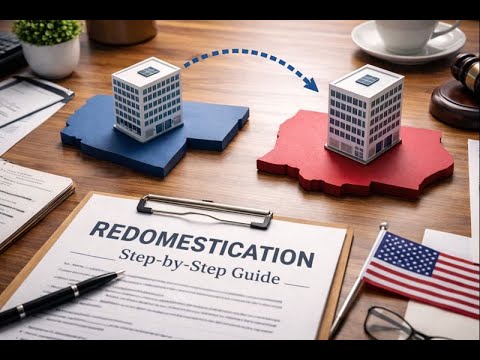
Click Here to Start Your Redomestication Now

The Redomestication Process in a Nutshell

1. Enter your biz name HERE.

Then click "get exact price" and follow the steps.

Takes less than five minutes.

Submit payment securely online then sit back and relax.

2. We prepare the legal docs.

Our dually-licensed attorney+CPA prepares the legal documents and sends them to you via DocuSign.

You sign. We take it from there.

3. We submit the legal filings to the states.

We monitor the status closely, respond to inquiries from their offices, and send you weekly updates.

No extra charge. 100% success rate.

4. Approved! ✅

We send you a checklist of go-forward obligations and simple steps for your tax pro to follow.

120% money-back guarantee if we do not succeed.

Did you know? The average business that moves to a state without state-level income tax saves over $12,500 in taxes per year.

Still have questions? Schedule a free meeting with our attorney and CPA.


Redomestication, also known as redomesticating, refers to the lesser-known legal process of transferring or moving the "home state" of an existing corporation, partnership, or LLC to a new state. It means keeping your existing company name, credit, and federal employer identification number (FEIN) without wasting time and money creating a new business entity, applying for foreign registration, or moving assets between companies.
— Prof. Chad D. Cummings, Esq., CPA

Why hire Cummings & Cummings Law?
Our Law FirmOther Law FirmsLegalZoom® /
RocketLawyer®
DIY
Licensed Attorney
Yes
⚠️
Varies

No

No
Licensed CPA
Yes

No

No

No
Owes you fiduciary duties under the law
Yes

Yes

No*
N/A
Experience
500+
⚠️
Varies

None*

None
Success Rate
100%
⚠️
Varies

Zero*

Who knows?
Money-Back Guararantee
120%
❌️
None

None*
N/A
Timeline 🚀
1-3 months
⚠️
6 months+
🔥
Months to fix
🔥
Months to fix
Expedite Option
Yes
⚠️
Varies

None
⚠️
Varies
Weekly Updates
No charge
💰️
At charge

None

None
Legal Fees
Flat-fee
⚠️
Varies
🔥
Very high to fix
🔥
Very high to fix
*It is illegal in all states to practice law without a license, and only a licensed attorney can render legal advice to or prepare custom legal documents for clients. LegalZoom®, RocketLawyer®, and similar services are not attorneys nor law firms and cannot perform redomestications.

Click Here to Start Your Redomestication Now

This page provides a consolidated index of our redomestication and entity migration resources.

All pages listed below relate to moving an existing business entity from one jurisdiction to another. To make navigation easier, the resources are grouped first by destination state, and then by the state the business is moving from.

If you are planning to move a company into Florida or Texas, start with the relevant destination section. Within each section, you can then locate guidance specific to your current state of formation. General resources that apply regardless of destination are listed separately.

This index updates automatically as new guidance is added, so you can use it as a reliable starting point when researching entity conversions, statutory domestications, and related planning considerations.


Click Here to Start Your Redomestication Now

Redomestication vs. Foreign Registration vs. Merger vs. Dissolution: A Comparison

Redomestication is a distinct legal process from foreign entity registration, merger, or dissolution.

Redomestication is generally the most efficient and cost-effective method for relocating a business to a new state, particularly when the company has permanently ceased operations in its original state. It does not involve dissolution. Many people make the mistake of dissolving their company when relying on incomplete or misleading advice.

Unlike foreign entity registration or merger, redomestication allows a business to retain its EIN, contracts, credit history, and brand identity—preserving continuity while minimizing tax risks and administrative burdens. It also eliminates the need to maintain dual registrations and tax obligations, potentially saving substantial time and money. By contrast, foreign registration can create ongoing compliance costs in the former state, and mergers often involve unnecessary legal complexity and higher fees.

Redomestication is, in many circumstances, far preferable to registering an LLC or corporation as a foreign entity, especially where the LLC or corporation has permanently moved its operations and will not be returning to the prior state in the near future.

Some attorneys, unfortunately, confuse their clients by recommending a foreign entity registration in the new state, or worse, a merger, where a redomestication would have accomplished the goals of moving their business to a new state efficiently and effectively.

The top seven benefits of moving your company (LLC, corporation, or partnership) to a new state via redomestication to transfer your business include:

  1. Maintaining your existing federal employer identification number, eliminating the tax headaches of forming a new company or transferring assets between companies (and inadvertently triggering a hefty tax bill from the IRS) when you move your business to a new state;
  2. Keeping your existing business credit history and track record, safeguarding your reputation with clients, vendors, and creditors when moving your LLC or corporation to a new state;
  3. Continuing your existing business name (in almost every case), protecting your most important assets when moving your company to a new state: your brand, reputation, and time you have already invested in search engine optimization;
  4. Maintaining your existing contracts with customers and vendors because moving your business to a new state via redomestication does not create a new company: it maintains your existing company, saving you dozens (or even hundreds) of hours re-writing (and re-negotiating) contracts and changing banks;
  5. Eliminating the need to continue paying registration fees and taxes in your prior state (assuming you have discontinued your operations there and have permanently relocated to a new state), potentially saving you tens of thousands of dollars (or more) in state taxes every quarter when you move your business to a new state;
  6. Avoiding unnecessary IRS scrutiny because moving your LLC or corporation to a new state via redomestication is a tax-free transaction under the Internal Revenue Code; and
  7. Reducing the amount of time you spend on administrative filings, saving you untold hours annually, by moving your company to a new state.

Before taking the "penny wise and pound foolish" approach of foreign entity registration or spending countless hours and exorbitant legal fees (and possibly taxes) on a merger or merger-gone-wrong to move your company to a new state, ensure you understand your options.


Comparison of Four Approaches
RedomesticateForeign EntityMergeDissolve
Need to Continue Paying & Filing Registration Renewals in Former State
No

Yes
⚠️
Varies
☠️
No, she's dead, Jim.
Stop Paying Taxes in the Former State*
Yes

No
⚠️
Varies
☠️
Tax event.*
Initial Complexity
Low
⚠️
Varies

High

High, when done right.
Ongoing Complexity
Very Low

High

High
☠️
None. All gone.
Initial State Filing Costs
Low
⚠️
Varies

High
⚠️
Varies
Timing
Fast
⚠️
Varies

Slow
⚠️
Varies
Legal Fees
Low
⚠️
Varies

$10,000 or more
🔥
Very high to fix.
*While every situation is different and dependent upon tax nexus, redomesticating can be an effective way to reduce or eliminate taxes in a former state in certain circumstances. Ask your CPA for more information. Our firm does not provide tax advice or perform tax work except by separate engagement at an additional charge.

In most circumstances, redomestication (and not a foreign entity registration or costly and complicated merger) is the best route to achieve a change in company domicile to a new state.

Why is redomestication the superior option to move a company from your prior state to ?

Redomestication keeps the business alive while moving its legal home to , which can allow the business to stop paying and filing annual registration renewals in your prior state if it has ceased operations there. The tax outcome depends on the facts and tax nexus, but the result is often that the redomesticated company has no remaining connection to your prior state, which can reduce or eliminate your prior state tax exposure.

Why is foreign entity registration inferior to redomestication when moving a company from your prior state to ?

Foreign entity registration keeps the company domiciled in your prior state and registers it to do business in , which means continuing to pay and file renewals and taxes in your prior state. The business now manages two or more state compliance tracks, increasing the chance that a missed renewal, registered agent change, or notice triggers penalties, loss of good standing, or disputes with banks and regulators.

Why is a traditional merger usually the wrong way to move a company from your prior state to ?

A traditional merger is a slower, higher-complexity path with legal fees that can reach $10,000 or more, and six or seven figures for complex transactions. When performed incorrectly, a merger may be a taxable event. The merger process also creates follow-on work: re-titling assets, harmonizing governing documents, novating and re-negotiating existing contracts, establishing new bank accounts, and repairing overlooked items that can surface years later. A single missed consent or broken assignment clause can convert a planned administrative exercise into a dispute or business interruption.

Why is dissolution the wrong way to move a company to from your prior state?

Dissolution kills the company. There is nothing left to move. Even if you think your company is dormant, breaches of contract, tax liabilities, and other claims may not surface until years down the road. If the company is dissolved, those claims may subject your personal assets to unlimited personal liability because the veil of protection for your company no longer exists. Dissolution can also trigger a taxable event under the Internal Revenue Code and the laws of your prior state. Redomestication, when performed by a competent attorney, is a non-taxable event.

Unless you are closing your doors and going out of business, dissolution should not enter the equation. If other professionals are suggesting dissolution, seek a second opinion. If you dissolve your company, you are not moving it; you are pulling the plug.


Click Here to Start Your Redomestication Now

Frequently asked questions: moving a company to from your prior state

Below are some of the most commonly asked questions our firm receives from business owners interested in transferring their company to from your prior state, prepared by a dually-licensed attorney and Certified Public Accountant.

  1. 1. What is redomestication?

    Redomestication is the process of legally transferring a company's home state from your prior state to . The company retains its existing name, credit history, contracts, bank accounts, and federal employer identification number (FEIN) without creating a new entity, transferring assets, triggering federal income tax, applying for foreign registration, or dissolving the original company.

    The company that exists after the redomestication is the same legal entity that existed before. It carries forward all prior history, rights, obligations, and liabilities as a matter of law. The process is authorized under the applicable statutes of both your prior state and .

  2. 2. How does redomestication differ from foreign qualification or merger?

    Business owners who wish to operate in often encounter three distinct legal mechanisms:

    • Foreign Qualification: The company registers in while remaining domiciled in your prior state, requiring ongoing compliance and fees in both states.
    • Merger: A new company is formed in and the original merges into it. This can trigger tax consequences and requires transferring contracts, bank accounts, and assets to the surviving entity.
    • Redomestication: The company itself changes domicile from your prior state to . No new entity is created. The FEIN, contracts, bank accounts, and credit history remain intact.

    Redomestication is, in most cases, the superior approach because it preserves continuity, avoids duplicate entities, and minimizes administrative and tax burdens.

  3. 3. How much does redomestication cost?

    For a one-time flat-fee plus state filing costs, our dually-licensed attorney and CPA prepares and files all required legal instruments to change the domicile of your company from your prior state to . The flat-fee covers the entire process from initial consultation through final confirmation of acceptance but excludes tax work.

    Many online services and some attorneys omit the preparation of a custom Plan of Conversion, which can result in a failure of the process and unforeseen tax and legal complications. We know of no other service that will perform all of these legal services to transfer your company to from your prior state at this competitive price.

  4. 4. Why should I transfer my business to ?

    imposes no state-level personal income tax. Most company types, including LLCs, S corporations, and partnerships, pay no state-level income tax or franchise tax. also offers strong asset protection statutes, a large consumer market, and well-developed infrastructure for business formation and compliance. Owners of pass-through entities who are also residents may realize meaningful tax savings at the state level.

  5. 5. What are the federal income tax implications of redomesticating?

    Redomestication is a form of non-taxable business reorganization recognized under Sections 351, 355, and/or 368(a) of the Internal Revenue Code (IRC) and applicable Treasury Regulations. When executed in compliance with the statutory requirements, transferring your company from your prior state to using this approach will not trigger any new federal income taxes at either the company or owner level.

    The tax-free treatment arises because the redomestication is a change in domicile only, not a sale, exchange, or distribution of assets. The company's tax attributes, including its basis in assets, carry forward without adjustment or new accounting.

    You will need to apprise the IRS of your new business address. Our firm can handle this administrative task for you at a nominal, additional charge.

    Important: The tax-free treatment of a redomestication depends upon strict compliance with all applicable requirements. Failure to prepare and adopt a proper Plan of Conversion, or failure to file the required instruments with both your prior state and , can jeopardize the non-taxable character of the transaction. This is one of several reasons why the Plan of Conversion, prepared by a competent attorney and CPA, is an essential component of the process.
  6. 6. How does the redomestication process work?

    The process proceeds in six steps: (1) complete the intake workflow on our website and submit payment; (2) our attorney prepares a custom Plan of Conversion, provided to you for review and signature via DocuSign; (3) our firm files documents with the Secretary of State; (4) upon acceptance, we provide you with filed and stamped documents; (5) our attorney files a statement of conversion with your prior state, completing the redomestication; (6) we provide guidance on next steps and ongoing filing requirements.

    Most online services and some attorneys omit Step 2 (the Plan of Conversion) and Step 5 (the filing with your prior state). These omissions can result in a failure of the process and unforeseen complications which may not be remediable.

  7. 7. What is a Plan of Conversion, and why is it important?

    A Plan of Conversion is the foundational legal document that authorizes and governs the redomestication. Both your prior state and law require its adoption as a prerequisite to filing. It sets forth the terms of the conversion, identifies the jurisdictions, and specifies the treatment of ownership interests. Failure to prepare and adopt a proper Plan of Conversion can result in rejection of the filing, a defective conversion, loss of the non-taxable character of the transaction, disputes among owners, and personal liability for those who authorized a defective transaction.

    Our attorney prepares a custom Plan of Conversion for every engagement. It is not a template or boilerplate form.

  8. 8. How long does the redomestication process take?

    The process typically takes two to three months from the date of engagement. The principal variable is the turnaround time of the Secretary of State and your prior state. When expediting is available, we can compress the timeline to less than a month. We provide weekly status updates throughout the process at no additional charge.


Click Here to Start Your Redomestication Now

Common misconceptions about redomestication

Below are some of the most common misconceptions our firm encounters when advising business owners on transferring their company from your prior state to .

  1. 1. "I need to form a new company in and dissolve the old one in your prior state."

    Incorrect. Redomestication changes the company's state of domicile without creating a new entity or dissolving the existing one. The company that exists after the conversion is the same legal entity that existed before. Its FEIN, contracts, bank accounts, and legal history remain intact. Forming a new entity and dissolving the old one can trigger tax consequences, require asset transfers, and disrupt existing contractual relationships.

  2. 2. "Changing my company's state of domicile will trigger federal income tax."

    When executed in compliance with the applicable statutory requirements, redomestication is a non-taxable reorganization under the federal Internal Revenue Code and Treasury Regulations. No gain or loss is recognized at the entity or owner level. The company's tax attributes, including its basis in assets, carry forward without adjustment. The critical condition is strict compliance: the company must adopt a proper Plan of Conversion, file the required instruments with both your prior state and the Secretary of State, and satisfy all procedural requirements of both jurisdictions.

  3. 3. "A Plan of Conversion is optional or just a formality."

    The laws of both your prior state and require the adoption of a Plan of Conversion as a prerequisite to filing. Omitting this document can result in rejection of the filing, a defective redomestication that may not be recognized as legally effective, and loss of the non-taxable character of the transaction under federal tax law. Many online filing services and some attorneys omit this step, which is one of the most common causes of failed conversions and future litigation.

  4. 4. "I only need to file paperwork with the Secretary of State to complete the conversion, and I can find a template online."

    A complete redomestication requires filings with both the Secretary of State and your prior state. Failing to file with your prior state can leave the company in a state of dual domicile, resulting in continued filing obligations, annual report requirements, and tax assessments in your prior state. The fill-in-the-blank templates found online are not specific to redomestication and may result in the unintentional termination of your company.

  5. 5. "My company will require a new FEIN after the redomestication."

    The company's federal employer identification number (FEIN) does not change as a result of redomestication. The IRS treats the converted company as the same taxpayer before and after the conversion. See I.R.C. § 368(a); Rev. Rul. 73-526, 1973-2 C.B. 404 (Situation 3); Rev. Rul. 64-250, 1964-2 C.B. 333; Rev. Rul. 2008-18, 2008-13 I.R.B. 674. A new FEIN would be required only if the company were dissolved and a new entity formed, or in the case of a traditional merger, which is not what occurs in a redomestication.


Click Here to Start Your Redomestication Now