
Change the state. Keep the company.
Move your LLC out of Minnesota via redomestication.
Start the process of transferring your LLC out of Minnesota in under five minutes.
Keep your existing contracts, credit history, and EIN.
Handled by a dually licensed attorney and CPA.
100% online. Flat-fee. No sales call required.








Executive Summary
Redomestication is the legal process of transferring a company out of Minnesota to Florida, maintaining the existing federal employer identification number (FEIN), contracts, bank accounts, and in most cases, LLC name.
- No Downtime: When executed by a professional, there is no operational or financial disruption.
- Complexity: This process exists at the intersection of federal tax law and the laws of Florida and Minnesota. It is not a "DIY" weekend project.
- Timeline: Redomestication takes about three months from start to finish, and expedite options are available. The intake process is entirely electronic, takes less than five minutes to get started, and can be completed on our redomestication platform here.
- Credentials: All work is handled by a dually-licensed attorney and CPA.
- Pricing: Pricing varies depending on the size of the company and is flat-fee.
- Get Started: No need to "request a quote." The exact price can be seen in under 30 seconds at the above link.
Move your LLC from Minnesota to Florida without turning it into a second job.
You can see the exact price in under 30 seconds, complete the online intake in less than five minutes, and receive the documents for e-signature within 48 hours.
Seven answers you should demand before hiring anyone to redomesticate your LLC.
A redomestication from Minnesota to Florida should not begin with uncertainty about price, timing, responsibility, or what happens if the filing encounters a problem.
| Ask this before you hire anyone | Cummings & Cummings Law | Any other provider |
|---|---|---|
| Can I see my exact price before I engage you? |
Yes. See the exact price online in about 30 seconds.
|
Often requires a sales call. Ask for the complete price in writing before you provide payment information. |
| How much of my time will the intake require? |
Less than five minutes for the online intake in a typical matter.
|
Ask whether calls, meetings, questionnaires, or manual document exchanges are required. |
| When will my legal documents be prepared? |
Within 48 hours after engagement and receipt of the required information. Faster if you choose to expedite.
|
Sometimes weeks. Ask for a specific preparation deadline, not an open-ended estimate. |
| Who actually prepares the legal work? |
Prof. Chad D. Cummings, CPA, Esq., M.S.T., LL.M., CMA, CFE, CIA, CRMA, CISA, CITP, FCPA, PFS, CFP personally prepares every document.
|
Confirm the name and credentials of the professional. Will it be an attorney, CPA, intern, paralegal? Where are they based? |
| Who submits and manages the state filings? |
We submit the required filings in Minnesota and Florida and address
filing-office inquiries during the process.
|
Confirm whether the provider files both sides of the transaction or leaves part of the process to you. |
| Will I receive status updates while the states review the filings? |
Yes. We provide weekly status updates via email every Friday at no additional charge.
|
Many firms only provide updates upon request. Ask how often you will receive an update and whether updates cost extra. |
| What happens if the redomestication cannot be completed? |
We will refund your filing costs and 120% of the legal fees you paid if we are unable to obtain the approval of the Department of State.
|
Ask for the provider's remedy in writing before you engage the provider. Check their credentials and track record with the state bar, BBB, and Google Reviews. |
Redomestication changes where your LLC is domiciled, not the identity of the business itself.
When handled by a professional, the same legal entity continues uninterrupted from Minnesota to Florida with no operational or financial disruption.
- Existing legal entity
- Existing FEIN
- Existing contracts
- Existing bank accounts
- Existing credit history
- Existing business history
- Same legal entity
- Same FEIN
- Same contracts
- Same bank accounts
- Same credit history
- Same business history
You provide the information and signatures. We take it from there.
Our engagement is designed for one task: changing the domicile of your LLC from Minnesota to Florida while preserving the company's continuity.
If our redomestication process does not fit your LLC, we will tell you.
If the information you provide shows that our redomestication service cannot be used to move your LLC from Minnesota to Florida, we will refund all of your costs and fees and inform you promptly before any instruments are filed. We will not waste your time or money.
In this circumstance, we will also suggest alternatives to explore with your tax professional, including referrals, where appropriate.
Your Redomestication Closing and Tax Continuity Packet.
After the redomestication from Minnesota to Florida is complete, we deliver the closing materials and practical next-step instructions for you and your tax professional.
![How to transfer your company to Florida and keep the EIN with zero downtime [step-by-step]](/onboard/yt-thumbs/VOv7Bk_TeDs.jpg)
How to transfer your company to Florida and keep the EIN with zero downtime [step-by-step]
![How to move a corporation from Illinois to Florida [step-by-step process]](/onboard/yt-thumbs/wHrWpDhyc0k.jpg)
How to move a corporation from Illinois to Florida [step-by-step process]
![How to transfer an Illinois LLC to Florida and keep the EIN [step-by-step]](/onboard/yt-thumbs/KgcqPdhB5dI.jpg)
How to transfer an Illinois LLC to Florida and keep the EIN [step-by-step]
![Attorney and CPA: How to transfer a corporation to Florida from Georgia [step-by-step]](/onboard/yt-thumbs/zRbC-J9U-50.jpg)
Attorney and CPA: How to transfer a corporation to Florida from Georgia [step-by-step]
![Attorney and CPA: How to move an LLC from Georgia to Florida [step-by-step]](/onboard/yt-thumbs/gxiHRO--IOU.jpg)
Attorney and CPA: How to move an LLC from Georgia to Florida [step-by-step]
![How to transfer a corporation out of New York to Florida [step-by-step]](/onboard/yt-thumbs/jl5bCTnaymg.jpg)
How to transfer a corporation out of New York to Florida [step-by-step]
![How to transfer an LLC out of New York to Florida [step-by-step]](/onboard/yt-thumbs/MVGZINVvd14.jpg)
How to transfer an LLC out of New York to Florida [step-by-step]
![How to move your company out of Minnesota and keep the EIN [step-by-step]](/onboard/yt-thumbs/F956F7DVZrM.jpg)
How to move your company out of Minnesota and keep the EIN [step-by-step]

Steps to transfer a company (LLC or corporation) to Florida

50 State Series: How to move your LLC or corporation out of Minnesota and keep your EIN
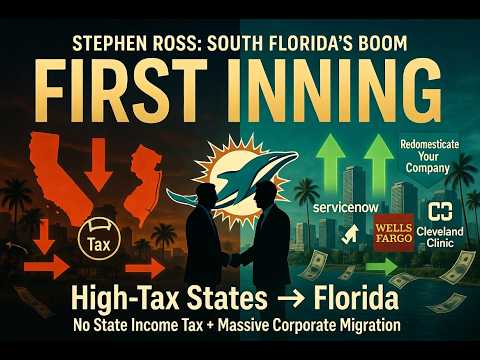
Report: Billionaire Stephen Ross says South Florida’s business relocation push in the '1st inning'
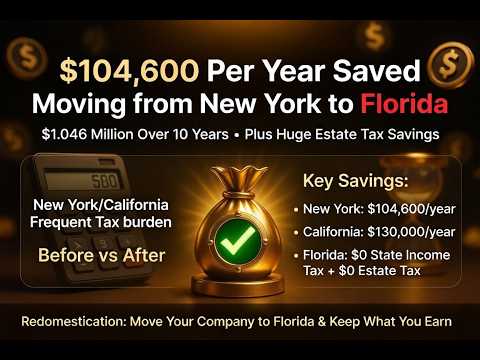
Report: How Much Americans Save on Taxes by Moving to Florida
How to transfer your company to Florida and keep the EIN with zero downtime [step-by-step]
How to move a corporation from Illinois to Florida [step-by-step process]
How to transfer an Illinois LLC to Florida and keep the EIN [step-by-step]
Attorney and CPA: How to transfer a corporation to Florida from Georgia [step-by-step]
Attorney and CPA: How to move an LLC from Georgia to Florida [step-by-step]
How to transfer a corporation out of New York to Florida [step-by-step]
How to transfer an LLC out of New York to Florida [step-by-step]
How to move your company out of Minnesota and keep the EIN [step-by-step]
Steps to transfer a company (LLC or corporation) to Florida
50 State Series: How to move your LLC or corporation out of Minnesota and keep your EIN
Report: Billionaire Stephen Ross says South Florida’s business relocation push in the '1st inning'
Report: How Much Americans Save on Taxes by Moving to Florida
Redomestication, also known as redomesticating, refers to the lesser-known legal process of transferring or moving the "home state" of an existing corporation, partnership, or LLC to a new state. It means keeping your existing company name, credit, and federal employer identification number (FEIN) without wasting time and money creating a new business entity, applying for foreign registration, or moving assets between companies.
— Prof. Chad D. Cummings, CPA, Esq., M.S.T., LL.M., CMA, CFE, CIA, CRMA, CISA, CITP, FCPA, PFS, CFP
Florida destination-state requirements
A redomestication of an LLC into Florida is governed by Fla. Stat. §§ 605.1041-605.1046 together with the law of Minnesota. The transaction requires an approved Plan of Conversion, Articles of Conversion, and the applicable Florida organizational filing. The Florida filing must be coordinated with the Minnesota outbound instrument so the same LLC continues without interruption.
Tax considerations when moving a LLC from Minnesota to Florida
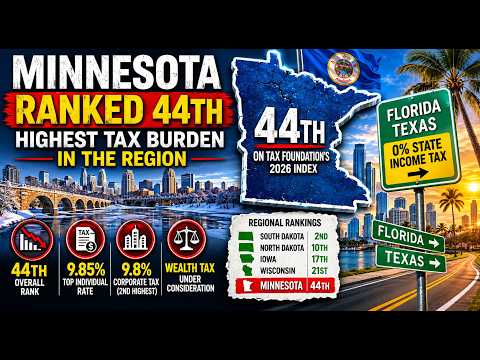
Minnesota imposes individual income tax at rates from 5.35 percent to 9.85 percent, with inflation-adjusted brackets. For 2026, the top bracket begins above $203,150 for single filers and $337,930 for joint filers under the official rate schedule. Minnesota's corporate franchise income tax is 9.80 percent. Pass-through entities generally allocate income to owners, but Minnesota separately imposes a minimum fee on many C corporations, S corporations, and partnerships, including LLCs taxed as partnerships. The 2026 minimum-fee schedule starts at $260 when combined Minnesota property, payroll, and sales reach $1.28 million, and rises to $12,830 at $51.28 million or more. Exceptions apply, including certain single-member LLCs reporting only on an individual's return.
The 2026 tax law extended Minnesota's elective pass-through entity tax through tax year 2027. Earlier guidance saying the election expired after 2025 is no longer current. The updated PTE guidance confirms the 9.85 percent rate and special treatment of 2026 estimated payments. The entity must pay its liability for owners to claim the corresponding credit. Separately, Minnesota imposes a 1 percent net investment income tax on covered net investment income exceeding $1 million. The PTE election does not automatically satisfy an owner's separate investment-income tax obligation.
Minnesota's general state sales tax is 6.875 percent, with local taxes added where applicable. The state also retains an estate tax with a $3 million exclusion and rates of 13 percent to 16 percent, as described in the estate-tax guidance; there is no separate inheritance tax. Owners of a LLC redomesticating from Minnesota to Florida should compare these taxes using the business's actual footprint and the owners' residence. Minnesota employees, property, or taxable sales can preserve obligations after the move. The state minimum fee is a tax calculation distinct from the Secretary of State's annual entity renewal, which is generally free for Minnesota corporations and LLCs in good standing.
The minimum-fee base measures Minnesota property, payroll, and sales, rather than net profit, so a loss does not automatically eliminate the fee. Retailers should use the state's sales-tax rate information to combine the general rate with the actual local taxes applicable to each transaction.
Florida imposes no individual income tax. A qualifying Florida resident therefore does not pay Florida income tax on wages, investment income, or ordinary pass-through business income. The state generally taxes C corporation income at 5.50 percent after Florida adjustments, apportionment, and the $50,000 exemption. An LLC classified as a corporation follows the corporate rules; an LLC's legal label alone does not determine its tax treatment. S corporations can have Florida corporate-tax obligations on certain federally taxable built-in gains or excess net passive income. A partnership or LLC taxed as a partnership can also have a Florida Form F-1065 filing obligation when it has a corporate owner; pass-through treatment does not make every information return unnecessary. The Florida Income Tax Code explains classification and filing requirements.
Florida's general sales tax is 6.00 percent, with county surtaxes where applicable. Effective October 1, 2025, Florida repealed sales tax and the related discretionary surtax on commercial real-property rentals. The enacted 2025 repeal provision in section 37 of H.B. 7031 establishes the effective date. Transient accommodations, parking, and other separately taxable rental transactions require their own analysis. Florida has no current separate estate or inheritance tax, but moving a business does not itself establish an owner's Florida domicile or entitlement to homestead benefits.
Redomesticating a LLC from Minnesota to Florida can reduce the costs of maintaining a company under a state law that no longer matches its operations. Tax savings depend on the owners' residence, tax classification, and where the business actually earns income. Employees, property, inventory, or other business activity remaining in Minnesota can preserve its income-tax, sales-tax, payroll, or registration obligations. Complete any required final returns before closing accounts.
Economic nexus also matters for an out-of-state seller without a physical office. South Dakota v. Wayfair, Inc., 585 U.S. 162 (2018), rejected the physical-presence prerequisite for sales-tax collection. A different, limited protection applies to certain solicitation of orders for tangible personal property under 15 U.S.C. § 381. Wisconsin Department of Revenue v. William Wrigley, Jr., Co., 505 U.S. 214 (1992), addresses that net-income-tax protection. It is not a general exemption from sales taxes or taxes on services. A state-by-state nexus review should identify each tax, applicable threshold, protected activity, and continuing filing duty.
Specific legal requirements to transfer a LLC to Florida from Minnesota
Minnesota has state-specific statutory, approval, filing, fee, and sequencing requirements that must be coordinated with Florida law. The requirements below are the origin-state requirements applicable to this transaction.
- Minnesota provides direct outbound routes for both LLCs and business corporations. An LLC uses Minn. Stat. 322C.1011 through 322C.1015 and Articles of Domestication. A corporation can use the broader conversion procedure beginning at Minn. Stat. 302A.682, which includes conversion to the relevant foreign corporation. The corporation therefore does not have to use an LLC form or assume that an interstate merger is its only available route. For a LLC moving from Minnesota to Florida, first confirm the existing entity type and the destination's authority to receive it. The name of the destination procedure can differ from Minnesota's terminology without eliminating the need to satisfy both states' substantive requirements.
- An LLC must prepare a Plan of Domestication. Section 322C.1011 requires the existing and destination names and jurisdictions, the transaction terms, and the manner in which membership interests will be converted. The plan also addresses the resulting organizational record and operating agreement. Identify every class of membership and state whether its economic rights remain unchanged. An LLC that remains an LLC uses this same-type domestication framework; a change to another entity type requires the appropriate conversion analysis. Approve the destination governing documents as part of the transaction, because retaining the same owners does not make the old Minnesota agreement automatically sufficient under destination law.
- LLC approval and personal-liability consent are separate questions. Section 322C.1012 supplies the all-member approval baseline and the applicable amendment or abandonment rules. Section 322C.1015 separately protects a member who would acquire personal liability after domestication, subject to its specific operating-agreement exception. A generic power to amend the operating agreement should not be assumed to satisfy that exception. Identify the general plan approval and any required individual liability consent in the transaction record. If the plan changes before filing, confirm who can authorize the change and obtain renewed approval for any alteration outside the authority already granted.
- LLC filing requirements appear in section 322C.1013. The articles statute requires the prescribed names and jurisdictions, approval statements, and destination information. A resulting foreign LLC that is not authorized in Minnesota must provide the required address for service-related purposes. An outbound LLC must also satisfy the surrender requirement in section 322C.1014, subdivision 3, identifying the LLC and stating that its Minnesota articles are surrendered in connection with the approved domestication. The Secretary of State's form contains this outbound information. Section 322C.1015 concerns personal liability, rather than being the principal filing-content or general effect provision.
- The official Minnesota LLC domestication form lists the applicable fee. The Articles of Domestication under chapter 322C lists $60 by mail or $80 for in-person service. Destination filing fees and any professional charges are additional. Complete the form for an outbound LLC and ensure the surrender portion matches the destination name and jurisdiction. The destination's formation document is governed by its own law; an incoming Minnesota formation attachment should not be substituted for the required outgoing record. Confirm acceptance evidence and the actual effective time under destination law. A request for future effectiveness should be coordinated with both filing offices before either document is released.
- A corporation prepares a Plan of Conversion under section 302A.682. The corporate conversion authorization requires the names and organizational forms before and after conversion, the destination jurisdiction, the conversion terms, and the resulting organizational documents. Section 302A.684 supplies the board and shareholder process. The shareholder meeting notice is generally given 14 to 60 days before the meeting, and the default shareholder approval uses a majority of the voting power of all shares entitled to vote, with applicable class and governing-document requirements considered. Address each class and any appraisal rights before filing; the LLC's member-consent provisions do not govern the corporation.
- Corporate Articles of Conversion must include the plan. Section 302A.686 expressly requires the Plan of Conversion as part of the public articles, together with the prescribed identity, approval, effective-date, and service information. An internal-plan-only approach would omit required Minnesota corporate filing content. Review confidential terms before finalizing the plan, while still including all information the statute requires. The Secretary of State's fee schedule lists $35 by mail or $55 for in-person service for the corporate conversion. The destination charge is separate. Do not use repealed intermediate sections in the corporate conversion sequence as authority for an additional document.
- Statutory effect provisions preserve identity and existing claims. LLC effects appear in section 322C.1014; corporate effects appear in section 302A.691. They provide the applicable continuity of the entity and its property and obligations without a separate liquidation. Pending proceedings and existing liabilities do not disappear when Minnesota domestic status ends. A resulting foreign organization remains subject to the prescribed Minnesota service arrangements for covered prior obligations. The closing memorandum should connect those rules with destination law and record the original organization or incorporation date. Federal tax classification and EIN treatment still require a separate review of the actual transaction, particularly if ownership or entity type also changes.
- Minnesota annual renewal is generally free for a domestic corporation or LLC in good standing. The Secretary of State's fee schedule also lists free renewal for a foreign LLC, while a foreign corporation's renewal carries a fee. A domestic entity's routine annual renewal should not be confused with a reinstatement charge or the Department of Revenue's separate minimum fee. Check the entity's actual registry status and cure any renewal problem before relying on that status for closing. A certificate of good standing may be required by Florida or a lender even if it is not a universal Minnesota outbound attachment. Order the evidence needed for the specific transaction and required age.
- Contract and licensing review should address the stated transaction triggers. Examine financing provisions that mention domestication, conversion, or a change of organizational law. Obtain required written consent before the effective time and determine which accepted documents the lender or bank will retain. A professional license or insurance record may need a separate update when the principal office or governing jurisdiction changes. Do not assume that a state-law continuity rule automatically satisfies those administrative duties. If the business will continue operating in Minnesota after the move, evaluate foreign qualification and registered-agent coverage; the special service-of-process provision for historical claims is not a substitute for ordinary registration to conduct business.
- Minnesota's 2026 PTE legislation changes the tax comparison for a current move. The Department of Revenue's current PTE guidance confirms that the election was extended through tax year 2027. Earlier guidance describing a post-2025 expiration is superseded by the 2026 change. Determine the election and estimated-payment treatment for the year containing the move, and account for Minnesota's separate minimum fee where applicable. Continued Minnesota-source operations may preserve business and owner reporting after the legal domicile changes. Returns should be marked final only when the relevant filing obligation ends, rather than whenever the Secretary of State accepts the domestication or conversion.
- Retain accepted records and assign the remaining compliance work. Keep the final plan and destination governing documents with the member or shareholder approvals, accepted filings from both states, and required status evidence. For an LLC, preserve the outbound surrender information; for a corporation, retain the exact plan included in the public articles. Record the actual effective time and any required third-party notices. Assign the first destination reporting deadline and any continuing Minnesota foreign-entity renewal to a responsible person. This makes the move traceable for a future purchaser or tax preparer and ensures that the legal filing is reflected in the business's operational records after closing.
