
Change the state. Keep the company.
Move your LLC out of Ohio via redomestication.
Start the process of transferring your LLC out of Ohio in under five minutes.
Keep your existing contracts, credit history, and EIN.
Handled by a dually licensed attorney and CPA.
100% online. Flat-fee. No sales call required.








Executive Summary
Redomestication is the legal process of transferring a company out of Ohio to Florida, maintaining the existing federal employer identification number (FEIN), contracts, bank accounts, and in most cases, LLC name.
- No Downtime: When executed by a professional, there is no operational or financial disruption.
- Complexity: This process exists at the intersection of federal tax law and the laws of Florida and Ohio. It is not a "DIY" weekend project.
- Timeline: Redomestication takes about three months from start to finish, and expedite options are available. The intake process is entirely electronic, takes less than five minutes to get started, and can be completed on our redomestication platform here.
- Credentials: All work is handled by a dually-licensed attorney and CPA.
- Pricing: Pricing varies depending on the size of the company and is flat-fee.
- Get Started: No need to "request a quote." The exact price can be seen in under 30 seconds at the above link.
Move your LLC from Ohio to Florida without turning it into a second job.
You can see the exact price in under 30 seconds, complete the online intake in less than five minutes, and receive the documents for e-signature within 48 hours.
Seven answers you should demand before hiring anyone to redomesticate your LLC.
A redomestication from Ohio to Florida should not begin with uncertainty about price, timing, responsibility, or what happens if the filing encounters a problem.
| Ask this before you hire anyone | Cummings & Cummings Law | Any other provider |
|---|---|---|
| Can I see my exact price before I engage you? |
Yes. See the exact price online in about 30 seconds.
|
Often requires a sales call. Ask for the complete price in writing before you provide payment information. |
| How much of my time will the intake require? |
Less than five minutes for the online intake in a typical matter.
|
Ask whether calls, meetings, questionnaires, or manual document exchanges are required. |
| When will my legal documents be prepared? |
Within 48 hours after engagement and receipt of the required information. Faster if you choose to expedite.
|
Sometimes weeks. Ask for a specific preparation deadline, not an open-ended estimate. |
| Who actually prepares the legal work? |
Prof. Chad D. Cummings, CPA, Esq., M.S.T., LL.M., CMA, CFE, CIA, CRMA, CISA, CITP, FCPA, PFS, CFP personally prepares every document.
|
Confirm the name and credentials of the professional. Will it be an attorney, CPA, intern, paralegal? Where are they based? |
| Who submits and manages the state filings? |
We submit the required filings in Ohio and Florida and address
filing-office inquiries during the process.
|
Confirm whether the provider files both sides of the transaction or leaves part of the process to you. |
| Will I receive status updates while the states review the filings? |
Yes. We provide weekly status updates via email every Friday at no additional charge.
|
Many firms only provide updates upon request. Ask how often you will receive an update and whether updates cost extra. |
| What happens if the redomestication cannot be completed? |
We will refund your filing costs and 120% of the legal fees you paid if we are unable to obtain the approval of the Department of State.
|
Ask for the provider's remedy in writing before you engage the provider. Check their credentials and track record with the state bar, BBB, and Google Reviews. |
Redomestication changes where your LLC is domiciled, not the identity of the business itself.
When handled by a professional, the same legal entity continues uninterrupted from Ohio to Florida with no operational or financial disruption.
- Existing legal entity
- Existing FEIN
- Existing contracts
- Existing bank accounts
- Existing credit history
- Existing business history
- Same legal entity
- Same FEIN
- Same contracts
- Same bank accounts
- Same credit history
- Same business history
You provide the information and signatures. We take it from there.
Our engagement is designed for one task: changing the domicile of your LLC from Ohio to Florida while preserving the company's continuity.
If our redomestication process does not fit your LLC, we will tell you.
If the information you provide shows that our redomestication service cannot be used to move your LLC from Ohio to Florida, we will refund all of your costs and fees and inform you promptly before any instruments are filed. We will not waste your time or money.
In this circumstance, we will also suggest alternatives to explore with your tax professional, including referrals, where appropriate.
Your Redomestication Closing and Tax Continuity Packet.
After the redomestication from Ohio to Florida is complete, we deliver the closing materials and practical next-step instructions for you and your tax professional.
![How to transfer your company to Florida and keep the EIN with zero downtime [step-by-step]](/onboard/yt-thumbs/VOv7Bk_TeDs.jpg)
How to transfer your company to Florida and keep the EIN with zero downtime [step-by-step]
![How to move a corporation from Illinois to Florida [step-by-step process]](/onboard/yt-thumbs/wHrWpDhyc0k.jpg)
How to move a corporation from Illinois to Florida [step-by-step process]
![How to transfer an Illinois LLC to Florida and keep the EIN [step-by-step]](/onboard/yt-thumbs/KgcqPdhB5dI.jpg)
How to transfer an Illinois LLC to Florida and keep the EIN [step-by-step]
![Attorney and CPA: How to transfer a corporation to Florida from Georgia [step-by-step]](/onboard/yt-thumbs/zRbC-J9U-50.jpg)
Attorney and CPA: How to transfer a corporation to Florida from Georgia [step-by-step]
![Attorney and CPA: How to move an LLC from Georgia to Florida [step-by-step]](/onboard/yt-thumbs/gxiHRO--IOU.jpg)
Attorney and CPA: How to move an LLC from Georgia to Florida [step-by-step]
![How to transfer a corporation out of New York to Florida [step-by-step]](/onboard/yt-thumbs/jl5bCTnaymg.jpg)
How to transfer a corporation out of New York to Florida [step-by-step]
![How to transfer an LLC out of New York to Florida [step-by-step]](/onboard/yt-thumbs/MVGZINVvd14.jpg)
How to transfer an LLC out of New York to Florida [step-by-step]

Steps to transfer a company (LLC or corporation) to Florida

50 State Series: How to move your LLC or corporation out of Ohio and keep your EIN
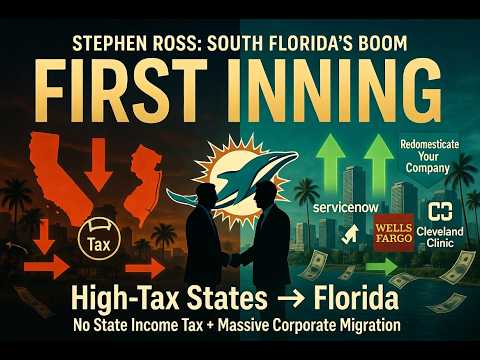
Report: Billionaire Stephen Ross says South Florida’s business relocation push in the '1st inning'

Report: How Much Americans Save on Taxes by Moving to Florida

Report: Years to Save for a Home by State and Why Business Owners Are Moving to Texas and Florida
How to transfer your company to Florida and keep the EIN with zero downtime [step-by-step]
How to move a corporation from Illinois to Florida [step-by-step process]
How to transfer an Illinois LLC to Florida and keep the EIN [step-by-step]
Attorney and CPA: How to transfer a corporation to Florida from Georgia [step-by-step]
Attorney and CPA: How to move an LLC from Georgia to Florida [step-by-step]
How to transfer a corporation out of New York to Florida [step-by-step]
How to transfer an LLC out of New York to Florida [step-by-step]
Steps to transfer a company (LLC or corporation) to Florida
50 State Series: How to move your LLC or corporation out of Ohio and keep your EIN
Report: Billionaire Stephen Ross says South Florida’s business relocation push in the '1st inning'
Report: How Much Americans Save on Taxes by Moving to Florida
Report: Years to Save for a Home by State and Why Business Owners Are Moving to Texas and Florida
Redomestication, also known as redomesticating, refers to the lesser-known legal process of transferring or moving the "home state" of an existing corporation, partnership, or LLC to a new state. It means keeping your existing company name, credit, and federal employer identification number (FEIN) without wasting time and money creating a new business entity, applying for foreign registration, or moving assets between companies.
— Prof. Chad D. Cummings, CPA, Esq., M.S.T., LL.M., CMA, CFE, CIA, CRMA, CISA, CITP, FCPA, PFS, CFP
Florida destination-state requirements
A redomestication of an LLC into Florida is governed by Fla. Stat. §§ 605.1041-605.1046 together with the law of Ohio. The transaction requires an approved Plan of Conversion, Articles of Conversion, and the applicable Florida organizational filing. The Florida filing must be coordinated with the Ohio outbound instrument so the same LLC continues without interruption.
Tax considerations when moving a LLC from Ohio to Florida
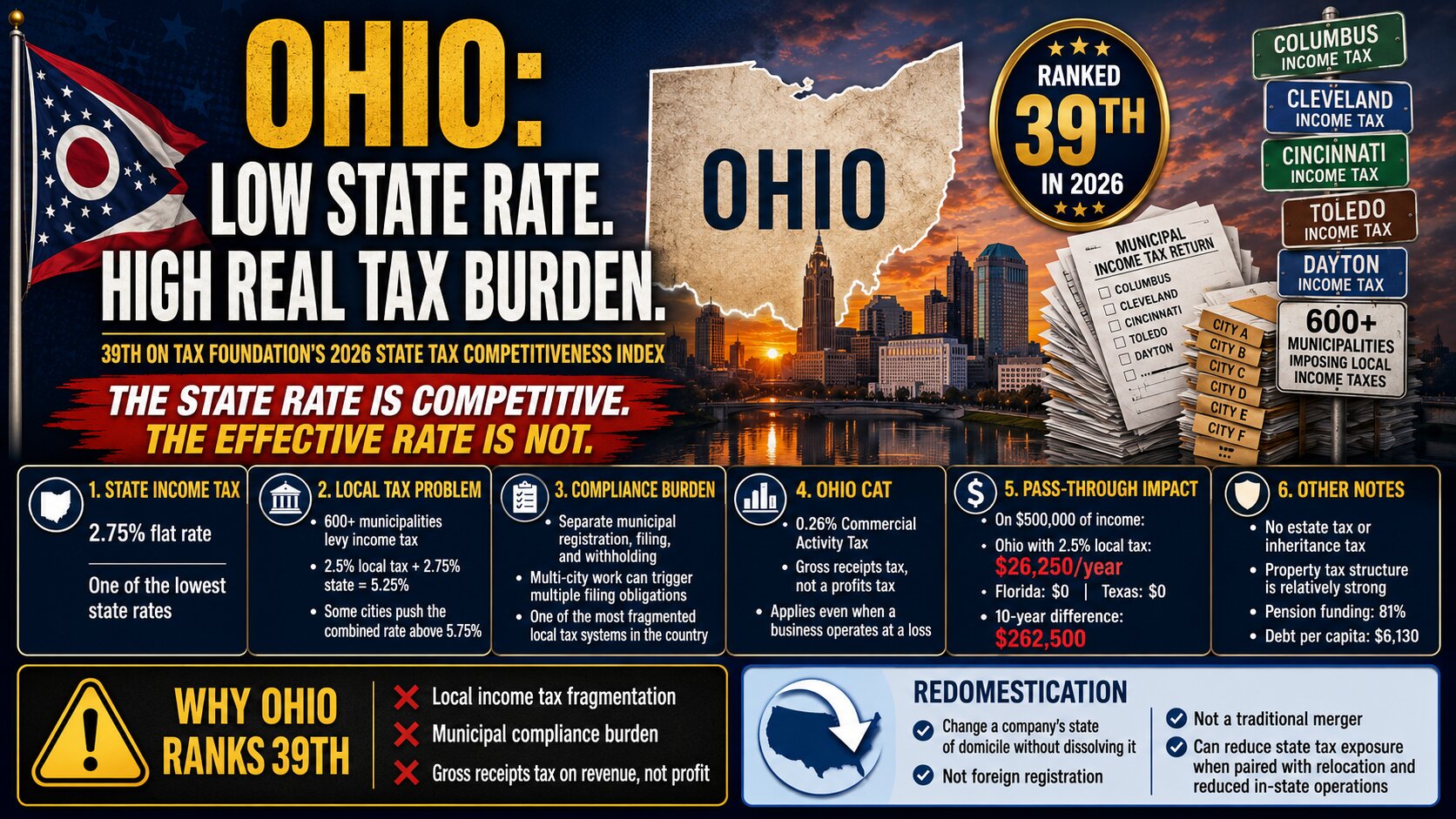
Ohio's 2026 individual income tax uses a 2.75 percent marginal rate on taxable nonbusiness income above the statutory threshold; taxpayers at or below $26,050 generally owe no state individual income tax. The calculation for taxpayers above that threshold includes a statutory base amount. Business income follows a separate rule: eligible taxpayers generally deduct up to $250,000 of business income, or $125,000 if married filing separately, and remaining taxable business income is taxed at 3 percent. Ohio's 2026 income-tax statute should be applied according to the type of income, rather than describing every dollar as taxed at 2.75 percent.
Ohio does not impose a conventional general corporate income tax. Its Commercial Activity Tax, or CAT, generally applies at 0.26 percent to taxable Ohio gross receipts exceeding the $6 million annual exclusion. That exclusion has applied since 2025; the former $150,000 threshold and annual minimum tax are obsolete. The CAT rate statute and the Department of Taxation's 2026 filing guidance explain the current framework. CAT can apply to pass-through businesses, including entities disregarded for federal tax purposes. For example, $8 million of taxable Ohio receipts generally produces $5,200 of CAT before credits, based on the $2 million above the exclusion. A low-margin business should compare this receipts-based exposure alongside taxes calculated on its income.
Eligible pass-through entities can also elect Ohio's entity-level income tax. Municipal income taxes remain a separate concern for business profits and owners' or employees' earnings. A company moving its charter must evaluate its actual Ohio workplaces and income sourcing, including any continuing local registrations.
Ohio's state sales tax rate is 5.75 percent, with local additions varying by county and transit district. Ohio has no estate tax for deaths on or after January 1, 2013, and no separate inheritance tax. Taxable Ohio property nevertheless remains subject to applicable property taxes.
For owners of a LLC redomesticating from Ohio to Florida, model the 2026 individual rate change separately from the business-income deduction, CAT, and local income taxes. Sales into Ohio may continue to count toward CAT after relocation. Account closure should follow the end of the particular filing obligation, not merely the issuance of a Florida charter.
Florida imposes no individual income tax. A qualifying Florida resident therefore does not pay Florida income tax on wages, investment income, or ordinary pass-through business income. The state generally taxes C corporation income at 5.50 percent after Florida adjustments, apportionment, and the $50,000 exemption. An LLC classified as a corporation follows the corporate rules; an LLC's legal label alone does not determine its tax treatment. S corporations can have Florida corporate-tax obligations on certain federally taxable built-in gains or excess net passive income. A partnership or LLC taxed as a partnership can also have a Florida Form F-1065 filing obligation when it has a corporate owner; pass-through treatment does not make every information return unnecessary. The Florida Income Tax Code explains classification and filing requirements.
Florida's general sales tax is 6.00 percent, with county surtaxes where applicable. Effective October 1, 2025, Florida repealed sales tax and the related discretionary surtax on commercial real-property rentals. The enacted 2025 repeal provision in section 37 of H.B. 7031 establishes the effective date. Transient accommodations, parking, and other separately taxable rental transactions require their own analysis. Florida has no current separate estate or inheritance tax, but moving a business does not itself establish an owner's Florida domicile or entitlement to homestead benefits.
Redomesticating a LLC from Ohio to Florida can reduce the costs of maintaining a company under a state law that no longer matches its operations. Tax savings depend on the owners' residence, tax classification, and where the business actually earns income. Employees, property, inventory, or other business activity remaining in Ohio can preserve its income-tax, sales-tax, payroll, or registration obligations. Complete any required final returns before closing accounts.
Economic nexus also matters for an out-of-state seller without a physical office. South Dakota v. Wayfair, Inc., 585 U.S. 162 (2018), rejected the physical-presence prerequisite for sales-tax collection. A different, limited protection applies to certain solicitation of orders for tangible personal property under 15 U.S.C. § 381. Wisconsin Department of Revenue v. William Wrigley, Jr., Co., 505 U.S. 214 (1992), addresses that net-income-tax protection. It is not a general exemption from sales taxes or taxes on services. A state-by-state nexus review should identify each tax, applicable threshold, protected activity, and continuing filing duty.
Specific legal requirements to transfer a LLC to Florida from Ohio
Ohio has state-specific statutory, approval, filing, fee, and sequencing requirements that must be coordinated with Florida law. The requirements below are the origin-state requirements applicable to this transaction.
- Ohio permits an LLC or business corporation to move to Florida using an outbound conversion when the destination law authorizes the resulting entity. The current LLC provisions are Ohio Rev. Code § 1706.72 through § 1706.723. A business corporation follows § 1701.792, together with the filing and effect provisions in §§ 1701.811 and 1701.821. Ohio's use of the word conversion can include a move into a foreign entity of the same general form. Accordingly, an LLC does not necessarily have to become a corporation to change its domicile. Identify the destination's corresponding inbound procedure before approving the Ohio transaction.
- An Ohio LLC prepares a written declaration of conversion under § 1706.72. The declaration identifies the converting company and the resulting entity, including their organizational forms and governing jurisdictions. It sets out the conversion terms and explains how membership interests become interests in the converted entity, with the organizational documents and other information required by the section. Under § 1706.721, the statutory consent rule is approval by all members. Review the operating agreement alongside Chapter 1706 to determine its effect on approval rights. Document the applicable voting rule before obtaining signatures, especially where ownership is divided among several classes or a manager acts for the company.
- The LLC then delivers a Certificate of Conversion under § 1706.722. The certificate is the public filing; the declaration is the underlying transaction document. The certificate identifies the company before and after conversion and confirms the required approval, with additional information required by the statute. Keep a final signed declaration in the company's records and ensure the certificate describes that same transaction. Ohio's modern LLC law is in Chapter 1706, so legacy references to Chapter 1705 should not be used to prepare a current conversion. A destination state's use of a different document title does not replace Ohio's certificate requirements.
- An Ohio business corporation uses a written declaration of conversion under § 1701.792. The board generally adopts the declaration and submits it to shareholders, with notice provided to all shareholders whether or not entitled to vote. The default approval threshold is two-thirds of the voting power, although the articles may provide a different permitted threshold of at least a majority; additional class votes can apply. The declaration must address the resulting entity's governing documents and the treatment of shares. Review the specific rules for conversion into a foreign corporation before applying an article provision concerning merger votes to the conversion approval.
- Ohio places a substantive limit on the corporate route: a corporation cannot convert if there are reasonable grounds to believe that the resulting entity would be unable to pay its obligations as they become due. Section 1701.792 also requires foreign-entity provisions concerning Ohio jurisdiction and service of process, and information relevant to continued authority in Ohio where applicable. These provisions preserve a route for existing claims after the company moves. Prepare the solvency analysis and process-address information while the declaration is being approved. A conversion filing should not be used to suggest that old creditors lose their remedies when the charter changes states.
- The corporate Certificate of Conversion follows § 1701.811 and must use the form prescribed by the Secretary of State. It identifies the entities and their jurisdictions before and after conversion, confirms authorization and gives the required information about the declaration and its records custodian. The current Ohio business filing forms and fee schedule identifies Form 700 for entities converting within or off the Ohio records, with a $99 filing fee. Form 800 concerns entities converting into Ohio and should not be selected merely because its title also refers to conversion. Destination charges remain separate.
- A converting Ohio corporation must also address the agency documentation referenced in § 1701.811(B)(4). § 1701.86(H) and (I) cover tax and employer-account evidence involving the Department of Taxation, unemployment contributions and workers' compensation, together with the required property-tax information. The law permits a qualifying affidavit alternative to specified receipts or certificates, subject to its notice and tax-information requirements. Consequently, the procedure is more specific than simply obtaining a generic certificate of good standing. Determine which evidence or affidavit applies to the corporation and include it with the conversion submission. Corporate conversion does not automatically release outstanding tax liabilities.
- Coordinate the effective date with the destination's required filings. Section 1701.811 ties the corporate conversion to completion of the applicable filing requirements and any properly specified later date. For an LLC, apply the effectiveness provisions associated with its certificate and the destination transaction. If the business will continue operating in Ohio as a foreign entity, address its authority and statutory agent in the conversion package where the governing provisions permit or require that information. Obtain filed copies from both jurisdictions. The goal is a documented transition that counterparties can verify, rather than two registry submissions whose effective dates or organizational identities do not match.
- The effect provisions in § 1706.723 for LLCs and § 1701.821 for corporations preserve the entity's continuity and its property and obligations. Existing litigation can continue, and the conversion does not itself erase liens or debts. Review contracts containing domicile-change restrictions and determine whether a secured lender requires advance consent. Banks may request certified transaction documents before changing their records. If the company owns Ohio real estate, consider recording appropriate certified evidence under the applicable statute and check the title records. Statutory vesting does not eliminate every practical record-update requirement associated with the move.
- Ohio generally does not require ordinary LLCs or for-profit corporations to file annual or biennial reports with the Secretary of State. The agency confirms this in its business filing warnings. This does not eliminate statutory-agent maintenance or tax filings for activity that remains in Ohio. A redomesticated LLC may still have Commercial Activity Tax exposure, municipal income-tax obligations or employer accounts, depending on its actual operations. Determine separately whether Ohio foreign qualification remains necessary. Relocating an owner's residence is also a separate question from changing the company's legal jurisdiction.
- Ohio's corporate conversion statute also imposes a specific deadline on certain challenges. Under § 1701.821(C), an action seeking to set aside a conversion for noncompliance with an applicable Revised Code provision must be brought within 90 days after effectiveness. That provision should not be described as extinguishing the entity's ordinary contractual debts or every possible claim, which are separate matters. Its practical significance is that required approvals and filing evidence should be complete when the transaction closes. Preserve the precise declaration approved by the shareholders and the filed certificate, with the agency documentation required for the corporate submission. If the transaction involves a foreign entity or property elsewhere, § 1701.821(D) also makes the effect provisions subject to the relevant other jurisdiction's law.
- Complete the post-conversion records with the approved declaration, shareholder or member consents and the filed certificates. If the plan is abandoned before effectiveness, follow the governing statute and any required cancellation filing instead of relying only on an internal resolution. Confirm the federal tax consequences of the specific transaction, including whether the company's tax classification or ownership changes. An unchanged entity form may support continuity, but a state-law conversion is not a universal guarantee of tax-free treatment or retention of every registration number. Use the final transaction structure when arranging the Ohio-to-Florida move and updating the company's tax and banking records.
