
Change the state. Keep the company.
Move your company out of Indiana via redomestication.
Start the process of transferring your company out of Indiana in under five minutes.
Keep your existing contracts, credit history, and EIN.
Handled by a dually licensed attorney and CPA.
100% online. Flat-fee. No sales call required.








Executive Summary
Redomestication is the legal process of transferring a company out of Indiana to another state, maintaining the existing federal employer identification number (FEIN), contracts, bank accounts, and in most cases, company name.
- No Downtime: When executed by a professional, there is no operational or financial disruption.
- Complexity: This process exists at the intersection of federal tax law and the laws of another state and Indiana. It is not a "DIY" weekend project.
- Timeline: Redomestication takes about three months from start to finish, and expedite options are available. The intake process is entirely electronic, takes less than five minutes to get started, and can be completed on our redomestication platform here.
- Credentials: All work is handled by a dually-licensed attorney and CPA.
- Pricing: Pricing varies depending on the size of the company and is flat-fee.
- Get Started: No need to "request a quote." The exact price can be seen in under 30 seconds at the above link.
Move your company from Indiana to another state without turning it into a second job.
You can see the exact price in under 30 seconds, complete the online intake in less than five minutes, and receive the documents for e-signature within 48 hours.
Seven answers you should demand before hiring anyone to redomesticate your company.
A redomestication from Indiana to another state should not begin with uncertainty about price, timing, responsibility, or what happens if the filing encounters a problem.
| Ask this before you hire anyone | Cummings & Cummings Law | Any other provider |
|---|---|---|
| Can I see my exact price before I engage you? |
Yes. See the exact price online in about 30 seconds.
|
Often requires a sales call. Ask for the complete price in writing before you provide payment information. |
| How much of my time will the intake require? |
Less than five minutes for the online intake in a typical matter.
|
Ask whether calls, meetings, questionnaires, or manual document exchanges are required. |
| When will my legal documents be prepared? |
Within 48 hours after engagement and receipt of the required information. Faster if you choose to expedite.
|
Sometimes weeks. Ask for a specific preparation deadline, not an open-ended estimate. |
| Who actually prepares the legal work? |
Prof. Chad D. Cummings, CPA, Esq., M.S.T., LL.M., CMA, CFE, CIA, CRMA, CISA, CITP, FCPA, PFS, CFP personally prepares every document.
|
Confirm the name and credentials of the professional. Will it be an attorney, CPA, intern, paralegal? Where are they based? |
| Who submits and manages the state filings? |
We submit the required filings in Indiana and the destination state and address
filing-office inquiries during the process.
|
Confirm whether the provider files both sides of the transaction or leaves part of the process to you. |
| Will I receive status updates while the states review the filings? |
Yes. We provide weekly status updates via email every Friday at no additional charge.
|
Many firms only provide updates upon request. Ask how often you will receive an update and whether updates cost extra. |
| What happens if the redomestication cannot be completed? |
We will refund your filing costs and 120% of the legal fees you paid if we are unable to obtain the approval of the Secretary of State.
|
Ask for the provider's remedy in writing before you engage the provider. Check their credentials and track record with the state bar, BBB, and Google Reviews. |
Redomestication changes where your company is domiciled, not the identity of the business itself.
When handled by a professional, the same legal entity continues uninterrupted from Indiana to another state with no operational or financial disruption.
- Existing legal entity
- Existing FEIN
- Existing contracts
- Existing bank accounts
- Existing credit history
- Existing business history
- Same legal entity
- Same FEIN
- Same contracts
- Same bank accounts
- Same credit history
- Same business history
You provide the information and signatures. We take it from there.
Our engagement is designed for one task: changing the domicile of your company from Indiana to another state while preserving the company's continuity.
If our redomestication process does not fit your company, we will tell you.
If the information you provide shows that our redomestication service cannot be used to move your company from Indiana to another state, we will refund all of your costs and fees and inform you promptly before any instruments are filed. We will not waste your time or money.
In this circumstance, we will also suggest alternatives to explore with your tax professional, including referrals, where appropriate.
Your Redomestication Closing and Tax Continuity Packet.
After the redomestication from Indiana to another state is complete, we deliver the closing materials and practical next-step instructions for you and your tax professional.
Redomestication, also known as redomesticating, refers to the lesser-known legal process of transferring or moving the "home state" of an existing corporation, partnership, or LLC to a new state. It means keeping your existing company name, credit, and federal employer identification number (FEIN) without wasting time and money creating a new business entity, applying for foreign registration, or moving assets between companies.
— Prof. Chad D. Cummings, CPA, Esq., M.S.T., LL.M., CMA, CFE, CIA, CRMA, CISA, CITP, FCPA, PFS, CFP
Destination-state legal requirements
The destination state must authorize the company to continue under its law, and its accepted filing must be coordinated with the Indiana outbound filing. The destination instrument, approval requirements, registered-agent requirements, filing sequence, and effective time vary by jurisdiction. The Indiana-specific requirements below remain separate and must also be satisfied.
Tax considerations when moving a company from Indiana to another state
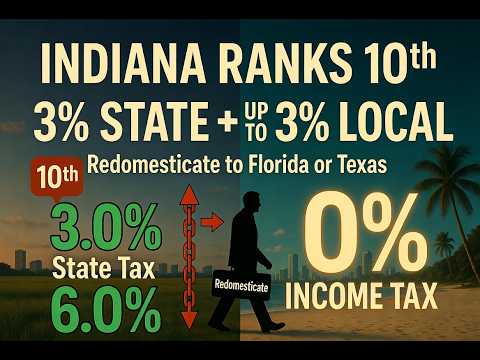
Indiana imposes a 2.95 percent individual income tax for tax year 2026, down from 3.00 percent in 2025. The enacted rate falls again to 2.90 percent in 2027. Indiana's corporate adjusted gross income tax rate is 4.90 percent. These are separate regimes: an LLC taxed as a C corporation uses the corporate rules, while partnership and S corporation income generally passes through to owners. Eligible partnerships and S corporations can elect Indiana's pass-through entity tax, which follows the individual state rate and generates owner credits. The Department of Revenue's rate schedule distinguishes tax years, and its PTET guidance explains the election. A distribution of cash is not required before an owner's share of business income becomes taxable.
Indiana's 7.00 percent general sales tax is statewide, without a general local sales-tax add-on. Separate local food-and-beverage or innkeeper taxes can nevertheless apply. Local income taxes are especially important: all 92 Indiana counties impose an individual income tax, and county rates can change in January or October. The state PTET election does not eliminate applicable county composite-tax obligations. Employers and relocating owners should consult the county tax information for the relevant work and residence locations. Indiana has no current inheritance or estate tax following the 2013 repeal.
For a company redomesticating from Indiana to another state, the practical comparison is the 2026 state rate plus applicable county tax, measured against destination taxes and continuing Indiana-source income. Changing the formation jurisdiction does not itself move an owner's residence or the business's employees. Indiana returns and withholding accounts should remain open for continuing taxable activity, with final returns filed only when the corresponding filing obligation actually ends.
For a business retaining Indiana employees, payroll withholding should reflect the applicable county rules as well as the state reduction. The 2027 state rate is enacted, while each county's separate rate schedule still requires review.
Specific legal requirements to transfer a company to another state from Indiana
Indiana has state-specific statutory, approval, filing, fee, and sequencing requirements that must be coordinated with the destination state law. The requirements below are the origin-state requirements applicable to this transaction.
- Indiana permits direct outbound domestication for both LLCs and corporations. The governing law is the Indiana Business Entity Transactions Act, Indiana Code 23-0.6, Chapter 5. The Secretary of State publishes the transaction statute and official explanatory comments. Under IC 23-0.6-5-1, an Indiana entity may become a foreign entity of the same type when the destination law authorizes the domestication. An LLC that remains an LLC uses this procedure. A change from an LLC to a corporation instead falls within the Act's separate conversion provisions. Confirm both states' authority before selecting documents for a company moving from Indiana to another state.
- Prepare a written Plan of Domestication before seeking signatures. IC 23-0.6-5-2 requires the entity's existing name and type, its destination name and jurisdiction, and the manner in which ownership interests will be converted. Include the resulting public formation document and the full text of private governing rules proposed to be in a record. For an LLC, this ordinarily means approving the destination operating agreement along with the transaction. For a corporation, reconcile the new articles and bylaws with outstanding share classes. The plan should state expressly whether ownership percentages and economic preferences continue unchanged, and should explain any change instead of relying on a general statement that the business is moving.
- Owner approval is a separate requirement from signing the public filing. IC 23-0.6-5-3 first applies any specific domestication approval rule in the governing law or documents. Where no such provision exists, the statutory merger fallback applies, including shareholder approval for the specified corporate merger procedure. For a noncorporate entity without an applicable approval procedure, all interest holders generally must approve. Additional consent rules protect owners who would acquire personal liability for entity obligations. Review the actual operating agreement or corporate voting provisions before circulating a consent. The approval record should show the voting threshold and the consenting ownership, and authorize a named representative to sign the Articles of Domestication.
- Plan amendment and abandonment need defined authority. IC 23-0.6-5-4 permits changes under the statutory rules and the approved plan, while protecting owners against specified changes to consideration, governing documents, or materially adverse terms without the required further approval. The filing representative should therefore be allowed to correct clerical errors without being given unlimited authority to change ownership rights. If the transaction is abandoned after Articles of Domestication have been submitted but before effectiveness, the required abandonment filing must reach the Secretary of State in time. Identify who can release or stop each filing and notify the other filing agent.
- The correct outbound document is Articles of Domestication, State Form 56358. The Indiana business-forms directory distinguishes the form for an Indiana entity domesticating to a foreign entity without changing entity type from other transaction forms. Its listed filing fee is $30; destination charges are additional. A Notice of Merger/Conversion is not a routine companion filing for every same-type domestication. That notice relates to its own described transaction circumstances. Selecting it automatically can create an inconsistent record. Match the existing Indiana entity number and legal name to the active record and use the direction-specific domestication form, rather than treating an incoming Indiana filing as interchangeable.
- The public articles have specific service and attachment requirements. Under IC 23-0.6-5-5, the articles identify the entity's existing name, jurisdiction, and type, followed by its destination name and jurisdiction and the required approval recital. If the resulting foreign entity is not registered in Indiana, provide both a mailing address and an email address for forwarding legal process. The attachment of a public organic record applies when the resulting entity is an Indiana filing entity; the destination state separately determines its own formation-document requirements. Indiana also allows a signed plan satisfying every required public-filing item to be filed instead of separate articles. That option makes the filed plan public, so review confidentiality before choosing it.
- Indiana permits a delayed effective date of up to 90 days after filing. IC 23-0.6-5-5 also specifies that an outbound domestication becomes effective at the later of the time determined under destination law or the effective time of the Indiana articles. This later-of rule makes the destination acceptance evidence an important closing document. Coordinate a common date and time where both states allow it, and preserve the filing receipts showing what actually became effective. A requested date is not proof of acceptance. If either office rejects the submission, reassess the uncompleted transaction before delivering final notices to banks or describing the entity as already governed by destination state law.
- Indiana business entity reports are generally biennial. The INBiz business entity report guidance explains the two-year cycle and the consequences of failing to file. Confirm the next reporting deadline against the specific entity record, especially if a report becomes due while the destination filing is being prepared. Resolve delinquency or administrative dissolution before relying on the entity's status for closing. The outbound articles statute does not list an Indiana good-standing certificate as a universal attachment. Nevertheless, another state may require a certificate of existence of a specified age. A lender may impose a separate certificate condition, which should be included in the closing schedule and budget.
- The business continues as the same entity after a valid domestication. IC 23-0.6-5-6 preserves entity identity without interruption and keeps property vested without a transfer, reversion, or impairment. Existing liabilities continue, and pending proceedings are treated under the statute rather than extinguished by the jurisdictional change. A direct domestication does not call for dissolving and liquidating the operating company as an independent preliminary step. It also does not remove a guaranty or erase an obligation owed before the move. The plan and closing memorandum should connect this Indiana continuity rule to the destination's corresponding effect provision, including how the destination records the original organization date.
- Review agreements that expressly address organizational changes. Loan covenants or commercial contracts may require notice or consent for a change of domicile even when the same legal entity continues to own its assets. Check the actual language concerning domestication and governing jurisdiction, and document any required lender approval before the effective time. Confirm the update procedure for regulated licenses and insurance records, particularly where the principal office will also move. The state-law continuity rule does not determine every federal tax consequence or automatically establish EIN treatment. Keep the legal-domicile change distinct from a tax-classification election or ownership restructuring occurring at the same closing.
- Remaining Indiana business activity may require foreign registration and continuing taxes. After the transaction, the destination state entity should evaluate whether its Indiana operations require registration as a foreign entity and an Indiana registered agent. The special statutory service address for prior claims does not eliminate those ongoing requirements. Indiana-source income or retained workers may preserve income-tax or withholding duties even though the company is no longer Indiana-organized. County income-tax obligations need separate attention because all Indiana counties impose local income tax, as described in the Department of Revenue's county guidance. Close tax accounts only when their filing obligations actually end.
- Retain the completed closing record. Keep the approved plan and owner approvals with accepted filings from both states. Record the effective time and calendar the first destination report and any continuing Indiana report.
- Indiana changed filing and address rules effective January 1, 2026. The Secretary of State's HB 1593 and HB 1666 guidance addresses principal-office and contact-address rules, including required disclosures for commercial mail receiving agency addresses. It also describes identity-verification duties for third-party business entity report submitters. Review those rules when correcting reports or selecting the address used in the closing records.
